
Equibase Company, the Thoroughbred industry’s official database for racing information, has launched a new performance-based horse rating that can be used to provide more options for tracks to consider when developing race conditions.
The first race using the Equibase Rating will be run on Oct. 24 at Santa Anita.
The Equibase Rating – which provides an algorithmically-generated predictive performance score based solely on race outcomes and measurable factors such as speed, race strength, track conditions, and trip factors – was developed with the input of industry stakeholders with the goal of simplifying conditions, improving race competitiveness, and creating larger fields.
“This has been a truly collaborative effort to improve race competitiveness and give horsemen additional options to complement claiming, especially for horses that have run through their conditions,” said Kyle McDoniel, president and COO for Equibase. “We are happy to partner with 1/ST to card the first race at Santa Anita and are excited about the interest already being generated by the new rating. I’d like to thank all of the participants in our various advisory groups who provided input from perspectives of racing offices, owners, trainers, breeders, and handicappers, as well as other jurisdictions outside of the U.S.”
As we’ve seen in international racing, a rating system provides horsemen and women more clarity in selecting a race for their horses,” said Aidan Butler, president of 1/ST. “Currently, the closest comparable option only exists with claiming races, whereas if you want a horse to run with others of similar class, you have to put them up for sale, which is counter-productive to owners and trainers investing long-term in their horses. We believe the introduction of the rating system to US racing will translate to horses running more often, leading to larger fields with increased wagering opportunities for our horseplayers.”
The Equibase Rating is calculated through an algorithm that factors in race records, performance analytics, and historical data from racetracks. It is different from the Equibase Speed Figure, which measures how fast a horse has been running in its past races with a single number and is based on the horse’s actual time in combination with the condition of the track.
The Equibase Rating will be incorporated into racetrack condition books for race planning and is available on equibase.com next to the horse’s name in entries, statistical profiles, and past performances.
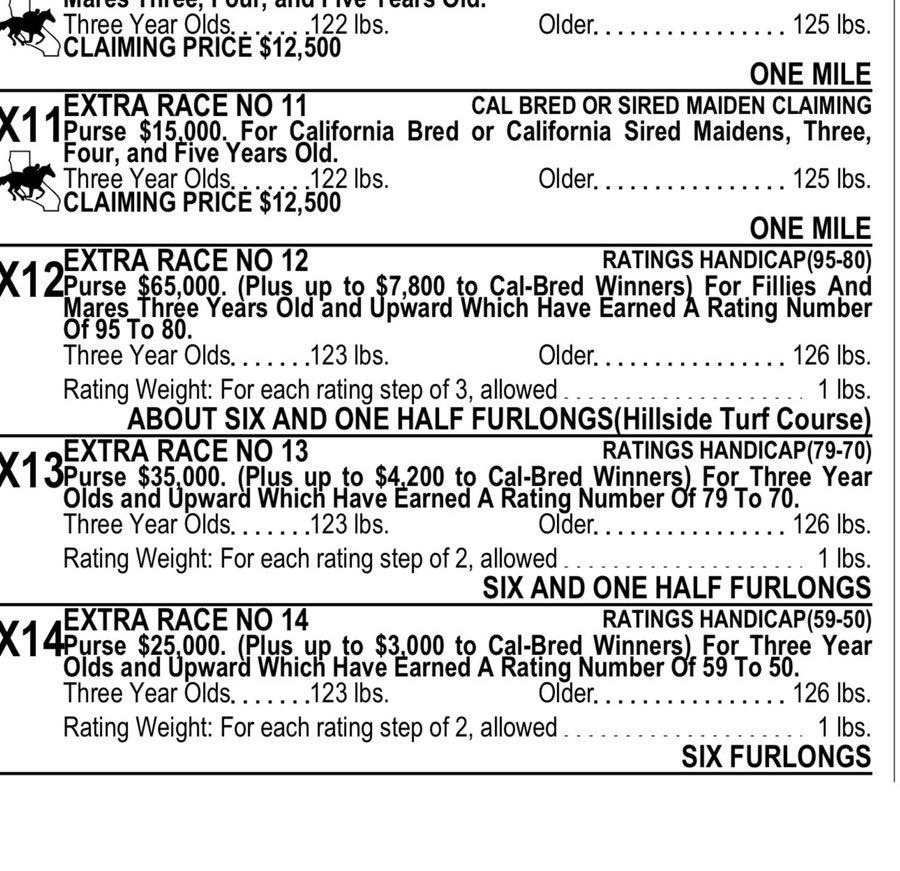
(Below – Santa Anita condition book, Extras 12, 13 and 14 are Ratings races)
Equibase Company is a partnership between subsidiaries of The Jockey Club and the Thoroughbred Racing Associations of North America and serves as the Thoroughbred industry’s official database. Through its website and mobile applications, Equibase offers a comprehensive array of free statistical information as well as premium handicapping products and reports in support of the North American Thoroughbred racing industry. Additional information is available at equibase.com.
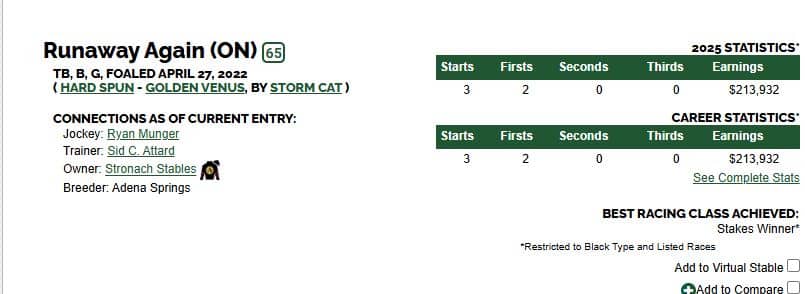
An example of Canadian horses with their horse ratings: RUNAWAY AGAIN, winner of the Prince of Wales Stakes, has a 65 rating but is very lightly raced. King’s Plate winner MANSETTI has an 82 rating and he’s had many more starts.
HORSE RATING – FAQ
General Overview
What is the Equibase Rating for North America?
The Equibase Rating is a standardized rating designed to assess and categorize the performance of racehorses across North America. It provides racing secretaries with a data-driven tool to create competitive race conditions leading to larger field sizes.
Why is the rating being introduced?
The Equibase Rating was developed to improve race competitiveness and align with industry best practices both domestically and abroad. It ensures fairer competition and better classification of horses, ultimately benefiting all stakeholders, including horsemen, racetracks, and bettors.
Who is leading this initiative?
The ratings initiative was spearheaded by Equibase in collaboration with industry stakeholders, including racing secretaries, data analysts, horsemen’s associations, and wagering experts.
How does the ratings work?
The rating uses a multi-factor algorithm to assess horses based on performance metrics, race class adjustments, surface and distance factors, track-specific variability, and recent form. These ratings will be updated daily to reflect ongoing race results.
How does a horse get a rating?
Initially, for a horse to be rated they must have at least two races. Their initial rating will be calibrated based on their performance and race quality in those races.
How does the rating handle different surfaces?
The rating has been calibrated in such a way to show a horse’s ability regardless of surface. This gives horsemen and trainers the ability to determine which racing surfaces best suits their horse’s running style.
How will ratings be displayed and accessed?
Ratings will be integrated into condition books for race planning. Initial access will be provided to racing secretaries, horsemen, and other key industry stakeholders as a starting point and eventually be made available to the public.
Is the Horse Rating the same as the Equibase Speed Figure?
No, the Equibase Speed Figure tells you how fast a horse has been running in its past races with a single number and is based on the horse’s actual time in combination with the condition of the track. The Horse Rating includes many other measurable factors as part of its calculation, including strength of the race, trip factors and recent form.
Impact on Racing Participants
How will the ratings affect trainers and owners?
Trainers and owners will have more clarity on race eligibility and horse placement. The Equibase Rating ensures fairer competition and better opportunities for horses to compete at appropriate levels. The Equibase Horse Rating was developed with the goal of adding more starts per horse as well as providing owners and trainers with the opportunity to keep horses in their programs for longer periods of time.
What impact will this have on bettors?
Bettors will benefit from increased transparency with more competitive and larger fields, leading to improved wagering options and engagement.
Will the Equibase Rating replace current race classifications?
No, the ratings will complement existing race classifications by offering an additional tool to structure competitive races. Traditional race classifications like Allowance, Claiming, and Stakes will still exist.
Stakeholder Involvement and Feedback
How are industry stakeholders involved in the development?
Working committees composed of racing secretaries, handicappers, data analysts, and strategic advisors were formed to help formulate the rating. The committees were organized into Conditions + Competition, Industry Alignment, Handicapping + Wagering, and Algorithm Development.
Technical and Governance Considerations
What data sources are being used for the ratings?
Equibase utilizes race records, performance analytics, and historical data from North American racetracks to calculate ratings.
Will ratings be mandatory for all tracks?
No, participation will be voluntary, but we believe tracks that adopt the system will benefit from improved race structuring and competitiveness.
How does the Equibase Rating align with international rating models?
The rating incorporates best practices from international jurisdictions such as Hong Kong, Dubai, and the UK, but was adapted to the unique structure of North American racing.
What measures are in place to ensure accuracy and fairness?
A dedicated oversight committee will monitor the system’s effectiveness, regularly update the algorithm, and address any discrepancies to maintain integrity and transparency.
What are the components of the Equibase Rating?
The Equibase Rating is a single, performance-based number that summarizes a horse’s ability relative to the quality of competition and race conditions. It is designed to be transparent, unbiased, and easy to compare across distances, surfaces, and tracks.
Rating = Performance Score + Race Strength Adj. + Track & Distance Adj.
Where:
Performance Score (Core Rating)
Performance Score = RS−(BL×BLF)−L+G
RS = Raw Speed (Time-Based, normalized by track distance average)
BL = Beaten Lengths
BLF = Beaten Length Factor (Scaling for sprint vs. route distances)
L = Layoff Adjustment (Exponential decay penalty)
G = Ground Gained or Lost (GPS-based adjustment)
Race Strength Adjustments (Competition Context)
Race Strength = (RCF)+(FSF)+(ΔSFNext Race)
RCF = Race Class Factor (Claiming, Allowance, Stakes Scaling)
FSF = Field Strength Factor (Average Speed Figure of Top 3 Finishers)
Delta SF_NextRace = Average Speed Figure Change of Horses in Subsequent Starts
Track & Distance Adjustments (Contextual Fairness)
Track & Distance = TV+TB+PP+RU
DTV = Track Variant for the Day (Run-up included in this metric)
TB = Inter-Track Variant
PP = Track Bias Adjustment
RU = Post Position Adjustment
Final Rating Formula in Full (Before Weighted Adjustments, etc)
Final Rating = (RS−(BL×BLF)−L+G)+(RCF+FSF+ΔSFNext Race)+(TV+TB+PP+RU)
More News