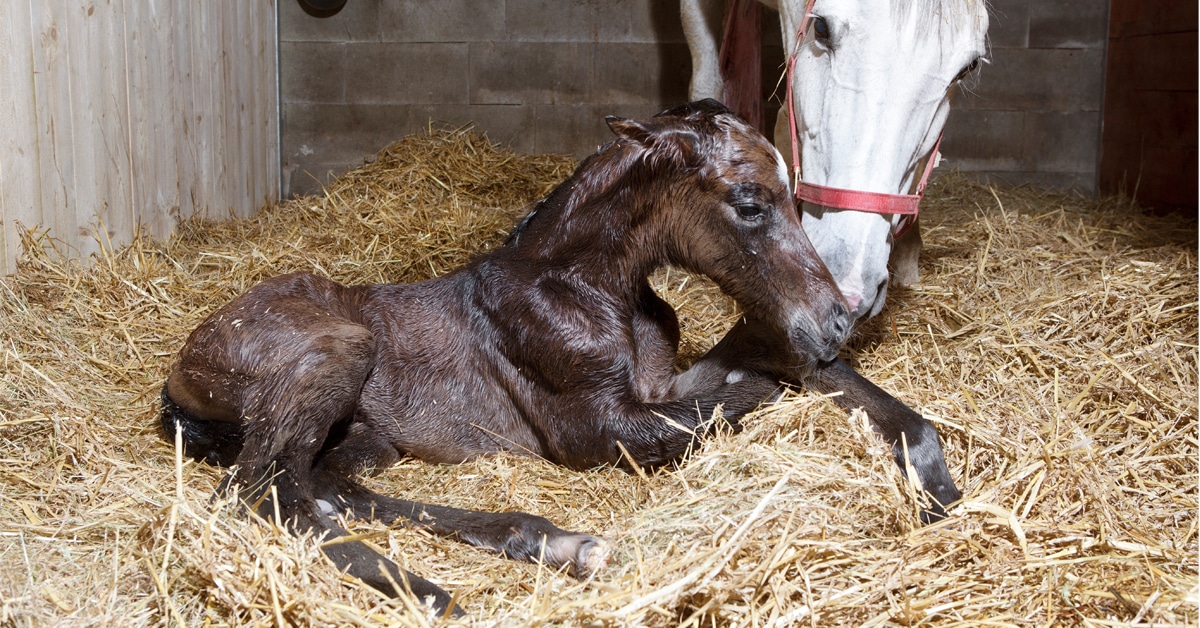
Kentucky Equine Research has released the findings of two Thoroughbred-related studies. The first looked at factors affecting birth weight in Thoroughbred foals born in Kentucky, United Kingdom, and Australia; the second examined Vitamin D levels in stabled racehorses with and without access to grazing.
Foal Weights
Researchers wanted to understand the factors that affect how much a Thoroughbred foal weighs at birth. They looked at gender, the mare’s age, parity (the number of foals the mare had previously had), month of birth, and location – Kentucky, UK, or Australia.
The birth weights of 3,062 foals from several farms across these regions were recorded over multiple years. researchers found that:
- Foals in Kentucky were the heaviest, averaging 56.5 kg, followed by the UK (55.3 kg) and Australia (53.9 kg).
- Colts were about 1.2 kg heavier than fillies everywhere.
The mare’s previous foaling experience (parity) had the biggest effect:
- Mares having their first foal had the smallest foals.
- Mares having their second foal had medium-sized foals.
- Mares that had three or more foals had the heaviest foals.
- On average, first-time mares’ foals were about 15% lighter than those from experienced mares.
- Month of birth also mattered: foals born earlier in the breeding season were smaller, but this was mainly because younger, less experienced mares tend to foal earlier.
- Mare age was closely linked to parity—older mares had usually had more foals.
Conclusions
While where the foal was born and its gender had some influence, the number of previous foals the mare had was by far the most important factor in determining birth weight.
Foals from first-time mothers were significantly lighter, which could affect their early growth and possibly their future athletic performance. The researchers suggest more work is needed to understand why parity has such a strong effect.
Racehorses and vitamin D
Horses, unlike humans, don’t produce much vitamin D from sunlight. Instead, they mostly get it from dietary sources such as grass, which contains a form called vitamin D₂.
Researchers compared racehorses kept in stables in Hong Kong (who are not grazed) with racehorses in the UK (who do graze). They found that the Hong Kong horses had considerably lower levels of vitamin D in their blood because they weren’t getting enough from their diet.
The study shows that stabled racehorses in Hong Kong need vitamin D supplements — especially vitamin D₃ — to avoid deficiencies. It also discovered a new link between the two main forms of vitamin D in horses (D₂ and D₃), similar to what’s seen in humans. More research is needed to determine which type and amount of vitamin D is best for racehorses. You can read the full research paper here.
More News