At a recent seminar, Sergio de Sousa, Managing Partner of Hidden Brook Farm in Kentucky, delivered a practical, no-nonsense presentation on preparing yearlings for sale. Speaking to breeders, sellers, and agents, de Sousa drew on decades of experience to walk through every stage of development — from weaning to turnout routines, feed management, walking prep, sale day presentation, and even post-sale insurance strategy.
His message was consistent: know your horse, manage your expectations, and prep for the market — not your emotions.
Feet & Feed are the Foundation
“One thing you can’t cure in two months is your horse’s feet,” de Sousa cautioned. Yearlings at Hidden Brook are trimmed every month—more often when they’re foals. While some yearlings need corrective trimming, de Sousa advised against pushing too far.
“These are young athletes and you have to help them grow through exercise, first and foremost.”
“I would rather see a horse that may toe in a little bit but the angle on their feet is nice and well balanced so when you pick up the foot you see the frog lined-up instead of one that is off sideways. I think that is something that will hurt your horse later on or take longer for them to get to the track. You have to balance your horse from the ground up.”
On the nutrition side, Hidden Brook relies on careful seasonal adjustments. “In Kentucky, the grass comes around in March and April and gets really strong. You try to keep them growing well until then and then reduce the feed intake.”
Hidden Brooks feeds sales prep horses a 14% protein feed that includes oils in a large pelleted feed, with no sweet feed on the farm.
“I don’t like heavy horses,” he said. “Heavy anything is a problem. These are young athletes and you have to help them grow through exercise, first and foremost.”
Routine, Turnout, and Early Education
De Sousa’s sale prep program emphasizes turnout and daily routines. “In my program at the farm, the yearlings come in every morning. They have their individual feeds, general grooming, and they go back out after a couple of hours.” That changes gradually as sales approach: “When the sales season starts in June for the September sale, I start walking my horses maybe three or four times a week — but I turn them out every day. As we get closer to the sale, every night.”
He carefully introduces routine changes to avoid stress. “Horses like routines and they don’t like drastic changes,” he explained. His team gets horses used to walkers, bit work, haltering, tying, and handling well in advance.
Walking, for de Sousa, is about education — not fitness
“I hand walk my horses that are doing well three times a week for 20 minutes. You walk, you come back to the area where we have the shows at the farm and we spend 5-10 minutes teaching the horse to show, stand, back-up, come forward, how to turn – just like if you are showing at the sale. You have to identify the horses that may need a little more and work with a little more often.
“I prep some of the horses in the field together. Not all of them, but the fillies, yes. I have some colts that I do together in good sized areas, but I take the troublemakers out,” noting that this group exposure simulates the busy sales environment.
During these sessions his team will determine what the best equipment is to use. Some horses will like the bar bit with keys, others will prefer the straight bit, some prefer the chain over the nose, and some horses relax best with a lip chain or a shank on the halter.
“You have to identify the trends in your horse on the farm, so it’s much easier when you get to the sale,” he explained. “The sale some horses react differently because it’s a big change for them and you have to figure out equipment, but at least you have a good idea of what worked for your horse at the farm.”
In his words, “you’re teaching them how to show — how to turn around, how to walk on with contact, show its full potential and be relaxed.”
Different equipment is used depending on the horse. “Some people use tack; I use a bungee cord that goes between their legs and ties up on the bit, but not tight. It really makes them use their hind end and helps them develop their backs.”
Final Weeks: Shoeing, Vets and Farm Shows
Shoeing is typically done once, often just the front feet, but de Sousa will shoe all around if he feels it will help his horse. Final shoeing is done about three days before shipping and horses continue to go out daily right up to sale day.
X-rays and scopes are done two to three weeks before the sale. “I call them dream crushers,” he admitted. “You spent two and a half years raising your foal, prepping the yearling, and then there’s something there. Nobody knows what it really means, but it’s there.” He emphasized the need to be prepared for criticism — and realistic about what it means. “Most horses that don’t run just aren’t very fast. I don’t think it’s the scope, the x-ray, or anything else.”
“For the seller and the buyer, farm shows are awesome,” de Sousa said. Hidden Brook begins these about three weeks before shipping. “You are showing what you practiced. It’s important for the buyers to see the horse in their environment where they are more relaxed.”
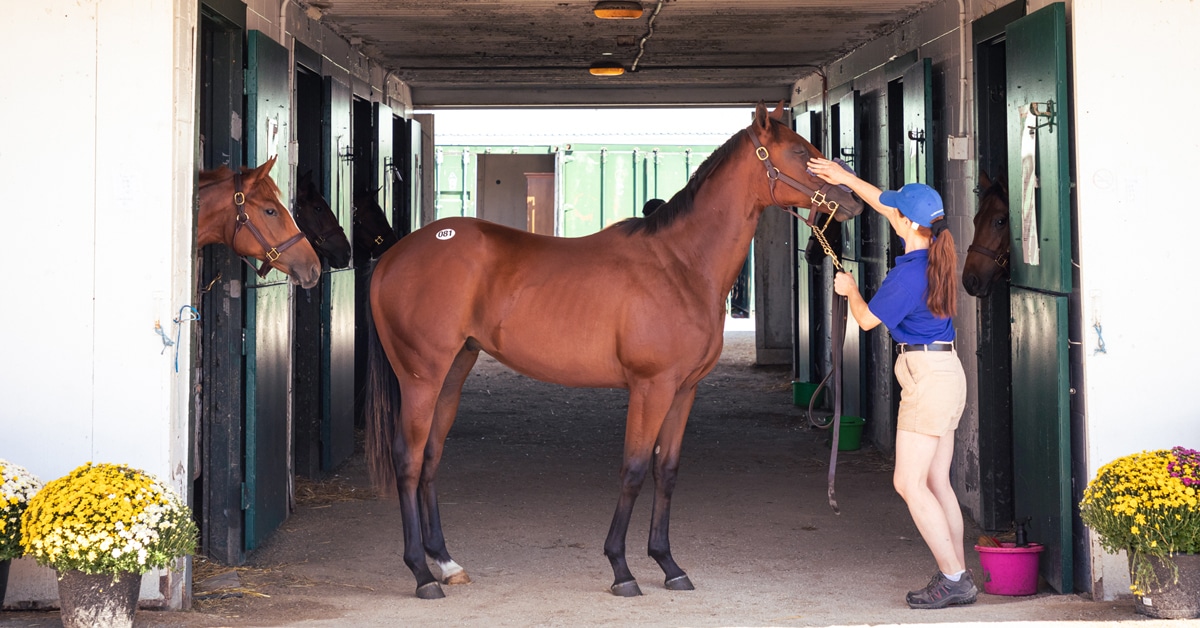
Presentation includes the horse, the shedrow, the signage, and the people.
Sometimes, a buyer may pass on a horse at the sale because it has a bad day — but if they’ve already seen it perform well at the farm the buyer may come back the next day to have another look.
Presentation and the Two-Minute Window
“After putting two and a half years in — make it look good,” de Sousa said. That includes everything from halters and shanks to your staff’s wardrobe. “Nice pants, nice shirt, nice shoes — they look okay. When they walk up to the barn, people see you have pride in what you produce.”
Presentation includes the horse, the shedrow, the signage, and the people. “Have people working for you that take the same pride as you—which is very difficult,” he admitted. “Your show person is the game changer when you are at the sales.
“You may only have two minutes to impress that buyer. It’s a quick impression.” His advice? “Find a good spot to show your horse. Try to get people to hang around, have a conversation, talk about your horse. Build a reputation.”
Choosing a Sale: Be Strategic, Not Emotional
When it comes to choosing the right sale or book, de Sousa urged realism. “The main factor is how fast you need money,” he (kind of) joked.
If you can get a good return on investment with a weanling it’s something to consider. For yearlings, the foaling date and maturity matter. Yearlings born later in the spring may be lighter, but some foals born earlier may simply not mature as quickly. “I don’t mind my horses going to the sales looking like yearlings—it is a yearling sale. They don’t need to look like they’re ready to get in the starting gate.”
In selecting a sale book, “you’re always better off being a little farther back at the sale. You have to be realistic. Better to be a book back than a book forward.
“Play the game — it is what it is…”
“I always set my reserve below what I think they are going to make,” de Sousa said. Even if there’s a lot of vetting activity or buyer buzz, he cautions against getting swept up. “The market is appraising your horse. Be careful not to get caught up in the action and noise.”
Sergio de Sousa’s approach to yearling sales preparation is rooted in horsemanship, realism, and respect for the process. From the ground up—literally with hoof balance—to the fine details of presentation and handler demeanor, every step is deliberate. His emphasis on thoughtful conditioning, knowing your individual horses, and preparing them for the demands of the marketplace reflects a deep understanding of both horses and buyers.
“Play the game — it is what it is,” he said, not as a dismissal, but as a reminder: success in the sales ring isn’t about shortcuts or sentiment. It’s about preparation, professionalism, and presenting the right horse, the right way, at the right time.
The Latest