Following are some main takeaways from a 2025 Ignite Applied Sports Science Exercise Physiology seminar entitled Using Data to Inform Training Decisions in Thoroughbred Racehorses with Romane Borrione, a performance and data analyst specializing in racehorses, based in Australia.
***
Training decisions are usually made by the trainer or assistant trainer regarding timing, distance, and race category. They are generally based on the trainer’s personal experience, knowledge base, and personal convictions. “If we combine this with sport science and data, this is pretty much what the ideal would be — making it an art as well as a science,” says Borrione.
In the modern horse racing industry, there are some challenges and limitations, the first being the limited knowledge of sports science among trainers, which is rarely used as a daily tool. With the growing importance of horse welfare and an increasing number of horses per trainer, the use of specific data will lead to improved performance and a reduced risk of injury, resulting in a better life for racehorses.
Borrione described her toolbox. “The three main data collection technologies that I use on a daily basis are the Equimetre device from Arionea, which records a number of parameters; the collection of lactates [via Lactate Pro2], which we do frequently when horses are worked on the treadmill; and genetic testing [via Plus Vital], which is also something I look at almost every day when reviewing a horse’s profile.”
The Equimetre device, placed on the horse’s girth, records various data including recovery parameters and insights such as heart rate, max heart rate, recovery time, electrocardiogram readings, and locomotion. “This will help you improve the training program, as you will get to know your horse better. You can then individualize its training,” suggests Borrione.
This information can be used by the trainer to adapt race strategies and advise the jockey on the horse’s preferred racing position, fine-tune career targets, identify specific racecourse preferences, etc.
“Then you have blood taken regularly by your vet to check the horse’s health, as well as lactates taken during treadmill exercises, which also help you better understand your horse’s fitness profile and metabolic response to exercise,” says Borrione.
“Finally, genetic testing is done here in Australia quite often, mostly when the horses are very young, to help determine their preferred racing distance. But you can also use it to adapt your training program to the horse’s specific genetic abilities.”
Case Studies
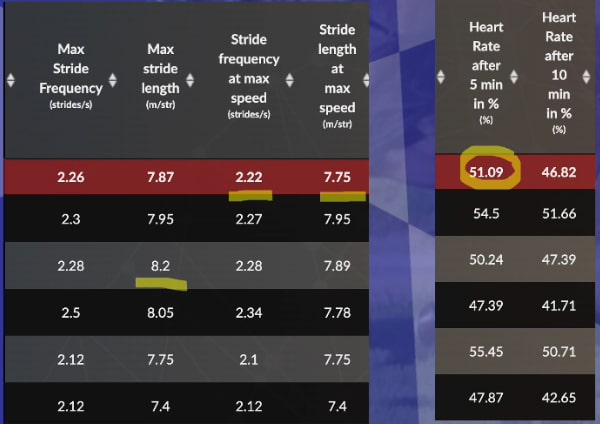
Case #1 involved a race distance optimization situation regarding a horse that wasn’t performing well at sprint distances. “I looked at his locomotion, his fitness, as well as his acceleration strategy,” recounts Borrione. “You’ll see (below) that he had a very big stride, but a very slow stride frequency, which means he needed a long time during the race to reach his peak speed.” His heart recovery rate, however, was excellent. “All these things indicated that this horse would be more performant over a longer distance, which is what I recommended to the trainer. The horse then went on to win his first start over 1,700 meters, then placed second in a listed race over 2,000 meters, and was successfully sold. So that was a good success story.”
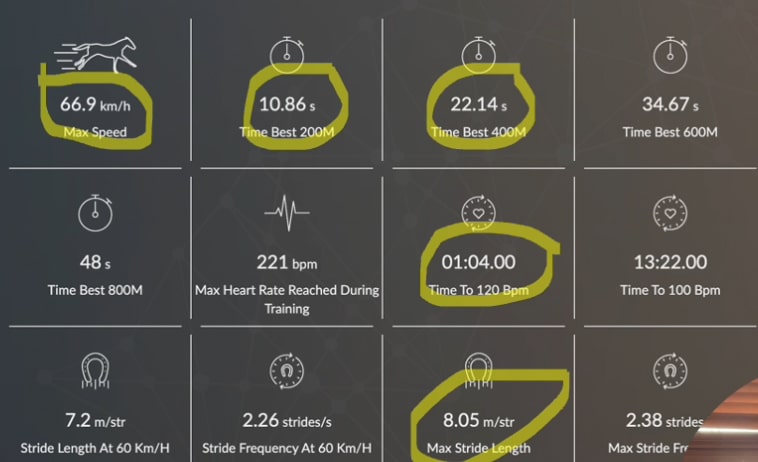
Case #2 involved a two-year-old Thoroughbred. “In this case, the horse was showing a lot of promise on the track in training. The trainer and the rider were both very happy with him. With the help of the data and looking at his pieces of work—for example (below) you have a gallop on the grass — he shows very good speed, good time at 200 meters and 400 meters, as well as excellent recovery. His max heart rate was very good on that day, and he also had a very big stride length, which is somewhat uncommon for a two-year-old.”
All of this information about the youngster pointed to strong performance potential on the track. “This horse was actually very good, and the data just confirmed the trainer’s and the rider’s feelings and gave the trainer confidence to race him. He went on to win a Group 1 race as a two-year-old, so that was also a very good outcome.”
One of the challenges facing the use of data to inform training decisions is the reluctance of some trainers to accept the daily use of devices. Data accuracy is also a concern, as horses are very unpredictable animals and a lot of outside factors can influence or skew the analysis.
“There’s also data overload,” warns Borrione. “As we collect more and more data, it’s easy to get drowned in too much information. Also, the limited scientific resources — compared to human sports science — are quite a constraint in the Thoroughbred industry.”
The Future
What does the future hold for sports science and its role in horse racing? Borrione predicts several areas that will continue to evolve and be increasingly utilized:
- Artificial intelligence and machine learning – “These are already being used, but even more in-depth applications are part of the future of sports science.”
- Genetic testing and genomic analysis – “Already used in other breeds for industrial purposes; I think in the Thoroughbred industry, it’s definitely something that will be explored further to help prevent injury and adapt training.”
- Remote training and telehealth – “The use of live data is already on the market and very useful, especially for trainers who can’t be present all the time. Or a vet can visit and send a report.”
- Smart equipment and gear – “One idea is sensors in horseshoes, which I thought was good. It was compared to the sensors made for human shoes that can detect pathologies such as dementia.”
Borrione believes it will be fascinating to see what other types of technology and genetic tests might be developed for racehorses in the future, increasing both data collection and data sharing while improving safety and welfare. “Obviously, that’s the goal that we always want.”
The Latest