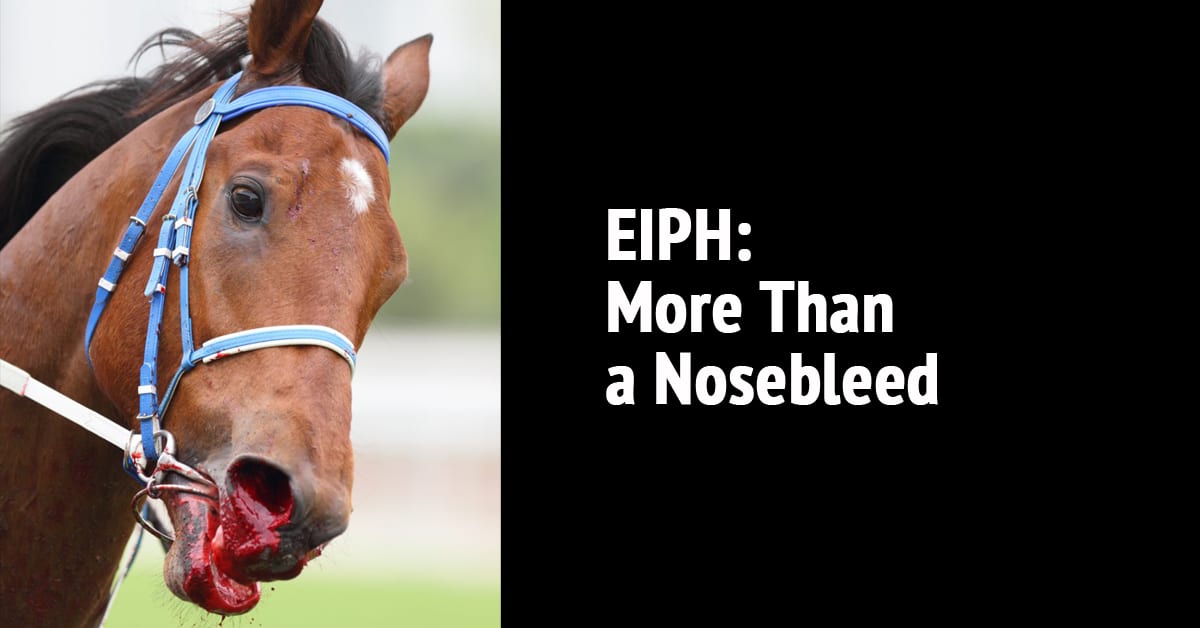
EIPH is more than a nosebleed, but just because most horses have it, and it doesn’t appear to harm performance, does that mean bleeding has no serious consequences?
No. Fifty years of research indicate that EIPH causes lung damage that builds up over time. These changes mean it is an actual disease and has consequences for respiratory health and athletic performance. This shift in understanding, together with what we now know about key risk factors, has changed how we manage and try to prevent EIPH. Written by Silvana Čeko, a horsewoman and PhD Candidate in Pathobiology at the University of Guelph, this article distills current EIPH research, with contributions from Drs. Amy Lack and Janet Beeler-Marfisi — professors and researchers in equine lung diseases at the Ontario Veterinary College.
Exercise‑induced pulmonary hemorrhage, EIPH or “bleeding”, has been recognized for centuries. The true cause of this disease was misunderstood until modern diagnostic tools revealed that bleeding actually comes from the lungs, not the nose. For much of its history, the condition was understood as the rare and dramatic episodes of nosebleeds (epistaxis) after intense work, and bleeding was seen as a one-off, colourful event in an otherwise healthy horse. With the advent of the tools of endoscopy and bronchoalveolar lavage (“lung wash”), it became clear that bleeding from the nose represents a relatively rare occurrence of a much more common lung condition. Today, EIPH is recognized as a widespread, seemingly silent feature of equine athletes, with studies finding it in up to 95% of Thoroughbred racehorses.
Historical Perspectives on EIPH: Early Observations to Modern Insights
EIPH was described as early as 1688 where horses were seen to have blood streaming from their nose after strenuous exercise. Bleeding was initially attributed to the rupture of fragile blood vessels within the nasal cavity due to increased blood pressure during exercise. However, this explanation was disproved as our understanding advanced.
By the 1970s, we realized that bleeding from both nostrils could not be fully explained by broken blood vessels in the nose, and researchers began to wonder whether the lungs were the source of the blood. A major turning point came in 1981 with the introduction of fibreoptic endoscopy, or “scoping”, which allowed us to directly see blood in the windpipe (trachea) and main airways to the lungs (bronchi) of horses. [1] Importantly, these observations led us to understand that EIPH can occur without a nosebleed. But whether EIPH could be considered a true disease, something that might actually be causing the horse harm, continued to be debated. In 2015, the American College of Veterinary Internal Medicine published a paper that combined findings of decades of research. This paper determined that because EIPH was so common, appeared in some bloodlines, was associated with lung damage, and had performance impacts, that it should be considered a true disease.[2]
Takeaway: EIPH is not just the “occasional nosebleed”, but a common and often invisible disease that causes lung damage, and continues to be researched today.
The Horse’s Lung and Why It Is Vulnerable
Horses are powerhouse athletes, and much of that ability comes from their incredible heart and lungs. During intense exercise, a galloping horse can take up to 133 breaths per minute, inhaling 5 gallons of air with each breath, compared to Olympic athletes who inhale about 1.3 gallons of air per breath. The air sacs of a horse’s lungs also have a large surface area—about half a football field, or 10 tennis courts compared to the surface area of a human’s lungs which is only about one tennis court. Each air sac is wrapped in a network of tiny capillaries. Like the air sacs, the walls of these capillaries are extremely thin. The high lung surface area and thin-walled capillaries are designed for rapid movement of oxygen into the blood and carbon dioxide out of the body (gas exchange), but this also means the capillaries are very fragile.
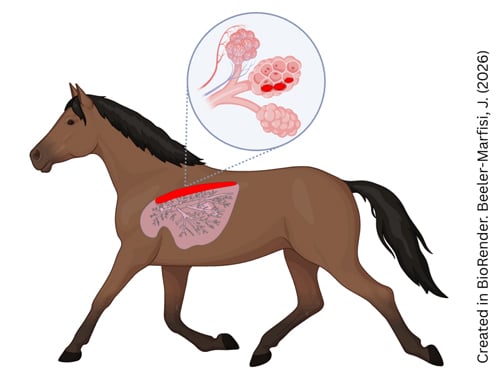
Illustration of a trotting horse showing where exercise‑induced pulmonary bleeding (EIPH) typically occurs in the back (dorsocaudal) parts of the lungs. The inset shows a close‑up of an air sac (alveolus) with blood pooled by gravity in the lower area to represent how blood can collect in the air sacs. (Created in BioRender. Beeler-Marfisi, J. (2026)
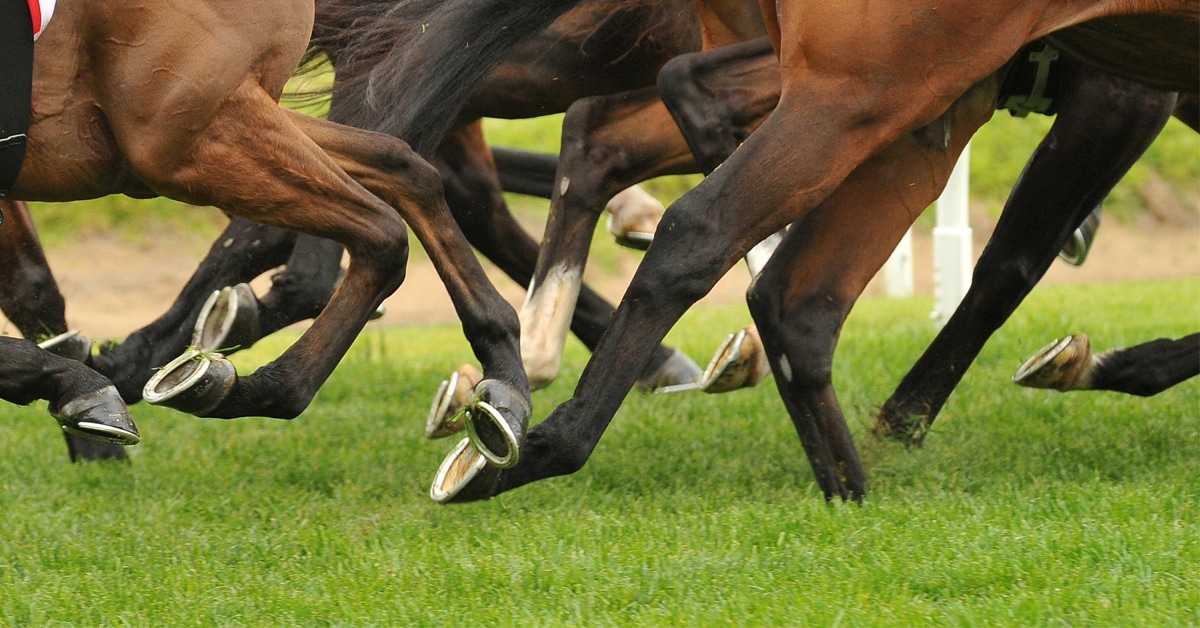
The lungs sit within the chest cavity, protected by ribs, supported by nerves and muscles, like the diaphragm, which all assist in breathing. At a gallop, a horse’s breathing is linked to stride (a pattern known as “locomotor-respiratory coupling”), which is why we often hear a breath for each stride. As the forelimbs reach forward, the rib cage expands and the horse inhales, then when the body compresses during the gathered phase of its stride, the lungs are compressed and air is pushed out causing a push-pull effect on the lungs. Ground impact, or hoof strike, also generates whole‑body vibrations, which are transmitted through the chest to the lungs with impact. [3] These events, combined with high heart rate and increased blood pressure, place the delicate capillaries of the lung under high physical stress. These factors combine to push the capillaries past their pressure limit, causing them to break. This breakage causes blood to leak into the air sac, which we recognize as EIPH. Finally, although the lung has a “self-cleaning” capacity which can heal the damage, this self-cleaning feature also causes inflammation that, in turn, leads to lung damage.
Takeaway: A horse’s lung is engineered for performance, but its design also makes it vulnerable to physical stress and injury during intense exercise.
EIPH in the Lung: Mechanisms, Injury, and Adaptation
Many factors go in to causing EIPH, but the most widely accepted explanation is a process known as “pulmonary capillary stress failure”. The lung region most affected by EIPH is the upper-back part of the lung (or, “caudodorsal region”). This area lies beside the diaphragm, receives high blood flow and undergoes physical stress during hoof strike.
Looking more closely, EIPH occurs during strenuous exercise due to a “push and pull” effect on the capillaries. “Push”, refers to the high blood pressure inside the lung capillaries, which pushes red blood cells against the capillary wall. “Pull” occurs on the air sac side, where negative pressure, which happens when the horse inhales, acts like a suction cup on the capillary wall. These push and pull forces can exceed the structural strength of the capillary wall. And that’s when blood gets into the air sac.
The cleanup crew of the air sacs are cells called macrophages. These cells gobble up the red blood cells and are the ones veterinarians see when they look at lung wash fluid and diagnose EIPH. But as the macrophages clear away the red blood cells, they also cause inflammation. Over time, this inflammation leads to scarring in the lung, especially around the capillaries. This scarring promotes EIPH by increasing capillary pressures.
Takeaway: EIPH is caused by lung capillary breakage from high pressure. Repeated EIPH episodes cause worsening lung damage. More damage means a higher risk of EIPH and reduced lung function.
Diagnosis Decoded
Epistaxis, or blood out of the nostrils, was once how EIPH was diagnosed. Today, we know that bleeding from the nose associated with EIPH happens in less than 0.2% of race starts. [4] This shows that most cases will be missed without scoping or lung wash.
The two most common methods of EIPH detection are post exercise scoping, formally known as “tracheobronchoscopic examination” and lung wash, or “bronchoalveolar lavage”. Scoping involves passing a fibreoptic endoscope into the windpipe to look for blood. Because EIPH starts deep in the lungs, the movement of blood toward the windpipe depends on how much blood there is and for how long the bleeding lasts, it can take 30 to 90 minutes after exercise for enough blood to reach the windpipe to be seen. Scoping too early or too late increases the risk of “missing” EIPH. Also, a horse should be scoped after 3 consecutive works to be sure the disease is ruled out. Presence of blood in the trachea after exercise is diagnostic of EIPH, with severity graded on a universal scale of 0 to 4, “none”, “mild”, “moderate”, “moderate-to-severe”, and “severe”. However, this method cannot confirm prior EIPH episodes, as it only detects bleeding on the day of the evaluation.
Lung washing avoids this problem by taking cells (macrophages) directly from the smallest airways and air sacs, making it the best method for diagnosing both current and past episodes of EIPH. The lung wash procedure involves flushing a small amount of saline into the air sacs then immediately removing it to send to the laboratory for analysis. The veterinarian at the lab looks at the cells from the air sacs to see how many there are and whether the red blood cells are fresh or older. These older red blood cells can be seen up to 21 days after a horse has bled. [5] This procedure requires sedation, specialized equipment and quick processing. Although it is considered minimally invasive, the horse should be monitored for fever and should not work for 24 hours after a lung wash.
Other methods to look for red blood cells include tracheal wash, and for evidence of lung damage, ultrasound, x-rays, or nuclear scintigraphy. Although evaluation of lung wash fluid is preferred, in the right hands tracheal wash can be relatively reliable and a less invasive substitute. Ultrasound and x-ray require a higher degree of lung damage before evidence of EIPH can be seen, so these tests are mainly used to monitor disease progression. Nuclear scintigraphy can detect disease well so long as other lung diseases aren’t present, but is generally only used in research.
Takeaway: Lung wash is the “gold standard” to detect past and present EIPH. Scoping is reliable if performed within 30-90 minutes post-exercise but requires at least 3 examinations to rule out EIPH. Tracheal wash can be performed, although BAL is still preferred if circumstances permit it.
How to Spot EIPH
- Coughing after exercise: Frequently mentioned, often observed.
- Poor performance or exercise intolerance: May only affect horses with EIPH scores >2.
- Epistaxis: Rare, but occurs most commonly with EIPH scores of 4.
Takeaway: EIPH signs are subtle, emphasizing the importance of monitoring, prevention and early intervention.
Understanding the Risk Factors
There is no single factor that determines EIPH risk. Research indicates that EIPH is collectively influenced by management, environmental, and physical factors. Risk factors for EIPH have been determined in the Northern and Southern hemispheres and include but are not limited to:
Age and accumulated time in training and racing
- Increasing age and lifetime starts are associated with higher EIPH scores, however this is closely linked to how long a horse has been in training and how many high-intensity exercise efforts it has experienced. [6] [7]
- Each additional year in training roughly increases the odds of EIPH by 1.5 times, which suggests that repeated work promotes cumulative lung damage. [7]
- Horses with >50 starts are 1.8 times more likely to have EIPH scores of moderate to severe. [8]
Takeaway: Horses who have been racing and training, and who have had more than 50 race starts, would benefit from increased EIPH surveillance and management.
Lower outdoor temperature
- In Australia, horses racing at temperatures below 68 ºF (20°C) are up to 2 times more likely to develop EIPH than at temperatures above 68 ºF. In North America, this has been observed in horses racing at less than 45 ºF (7 ºC) and less than 5 ºF (-15 ºC).[8]
Takeaway: Intense exercise in colder temperatures may warrant extra caution in horses known to have EIPH.
Ambient air pollution
- Recent and previous research sponsored by Equine Guelph at the University of Guelph showed that ozone as a part of air pollution from road traffic and wildfire smoke increased the likelihood and severity of EIPH, and other components of air pollution caused lower airway inflammation in racehorses. [9] Recent research from the U.S.A. supports that an air quality index > 100 was associated with EIPH in Thoroughbreds racehorses. [10]
Takeaway: Consider consulting air pollution metrics (especially ozone) when planning training and racing activities.
Race distance
- The data is conflicting on whether race distance affects EIPH, with some researchers finding that horses racing distances of 6-7 furlongs (1,300-1,500 meters) had worse EIPH than 2-year-olds racing in shorter faster races or longer slower ones. [11] But another study found the opposite. [8]
Takeaway: Race distance interacts with speed to influence EIPH risk.
Bar shoes
- In Australia, horses shod with bar shoes were substantially more likely to experience, and have moderate-to-severe EIPH than horses without bar shoes. Suggested to be linked to hoof pain and altered hoof strike mechanics, and heart/lung strain. [12]
Takeaway: Alternatives to bar shoes may warrant consideration for horses susceptible to EIPH.
Upper airway obstruction
- Upper airway obstruction (dorsal displacement of the soft palate, laryngeal hemiplegia) hampers breathing, which may add pressure to the capillary wall, promoting EIPH. Studies do not agree on whether using nasal strips helps prevent EIPH. [15, 16]
Takeaway: Horses with upper airway conditions may benefit from increased EIPH surveillance and management.
Length of rest period between races
- For horses with previous moderate or moderate-to-severe EIPH increasing the number of days between races reduced EIPH score on their next examination. Intensity during racing preparation can increase EIPH severity. [13]
Takeaway: Increasing rest periods between races, and limiting intense exercise close to a race reduces EIPH risk.
Genetics
- EIPH is known to run in some bloodlines, but there is not one “EIPH gene”, rather the disease is caused by the interaction of several genes in conjunction with all the aforementioned risk factors.[14]
- Not all horses from these bloodlines have poor race performance, but there is lung damage being done.
Takeaway: We can’t change genetics, but we can monitor horses more closely.
EIPH Treatments
The only research-backed treatment shown to reduce EIPH severity is furosemide. Because it is a diuretic that causes increased water loss through increased urination, furosemide reduces blood fluid volume, which decreases pressure on the capillary wall. However, furosemide use is not permitted in every racing jurisdiction.
Drugs like aminocaproic acid, bronchodilators, corticosteroids, nonsteroidal anti-inflammatory drugs (NSAIDs), or pentoxifylline have been evaluated for reducing EIPH severity, but there is little to no scientific evidence that any of them work. This is largely because EIPH is not associated with an inability to clot blood, nor with airway constriction. Prevention therefore relies on careful management and monitoring of equine athletes.
Newer therapies like platelet-rich plasma (PRP) and stem cells are often discussed, but there is little scientific evidence to support their use. In one study, PRP was delivered to the lungs of horses using an endoscope and was shown to reduce EIPH. [15] However, that was a single study involving a small number of horses, and more studies would be required to support this finding. To the authors’ knowledge, no papers on stem cell use for treating equine lung conditions are currently available. As for nasal strips, the evidence suggests that they help reduce EIPH, but neither nasal strips or furosemide, even in combination eliminate the issue entirely. [16-19]
Conclusion
Our understanding of EIPH has come a long way, and although there is still much to discover, many aspects of prevention lie within the day‑to‑day management of the horse. Thoughtful training progression, appropriate rest, attention to airway health, and careful management of environmental conditions all offer practical ways to reduce risk and support the horse’s long‑term health.
If you found this article interesting and would like to learn more about EIPH, we encourage you to explore the literature referenced below. For more equine education, explore courses at Equine Guelph in partnership with School of Continuing Studies at the University of Guelph and TheHorsePortal.ca
(See original article HERE for references)
The Latest