When it comes to their feet, Thoroughbreds need some special care. Known for underrun heels, long toes and thin soles, Thoroughbreds can be prone to hoof problems. However, keeping these horses in top form often comes down to attention to detail and an individualized program that addresses the many factors contributing to hoof stress and eventual breakdown.
“Thoroughbreds are known historically to have under-run heels and be longer in the toe; that is just how their feet are put together. How you manage it can lead to chronic issues if you do not get the balance figured out,” says equine veterinarian Dr. Alex Knoepfli, a partner at Prescott Animal Hospital in Prescott, ON.
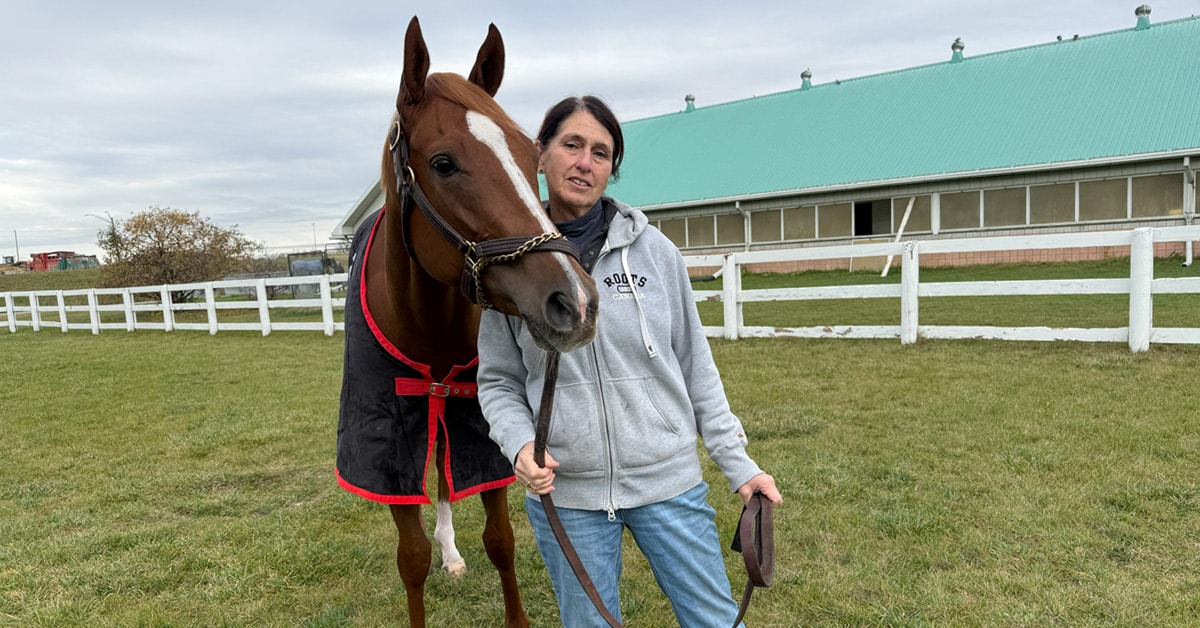
Carol Mott, who has extensive experience with off-track Thoroughbreds (OTTBs), operates The Motts Equestrian Centre, a hunter/jumper facility, with her husband Paul.
“Thoroughbreds have wonderful brains, an incredible work ethic, and are athletic. The downside is their feet. It’s not that warmbloods don’t have issues, but from my experience it’s not as often.”
While Thoroughbreds may have some characteristic hoof challenges, there is no single formula for managing them. Conformation, training demands, footing, shoeing, trimming, stabling and daily care all play a role. The key is understanding the individual horse and adjusting its hoof-care program accordingly.
The Demands on the Hoof
Racing places considerable demands on a horse’s body, and the feet are no exception. “Since racing is the most demanding on a horse’s body, it stands to reason that their feet would take a beating,” says Mott. “It may be as simple as pads to protect a thin sole, or there may be some corrective shoeing needed. If you have a good blacksmith and vet, between the two of them they will come up with a plan.”
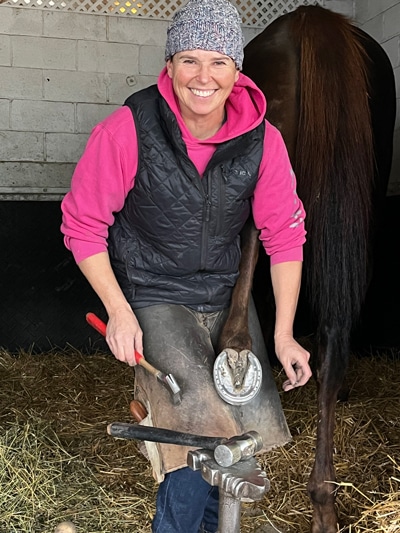
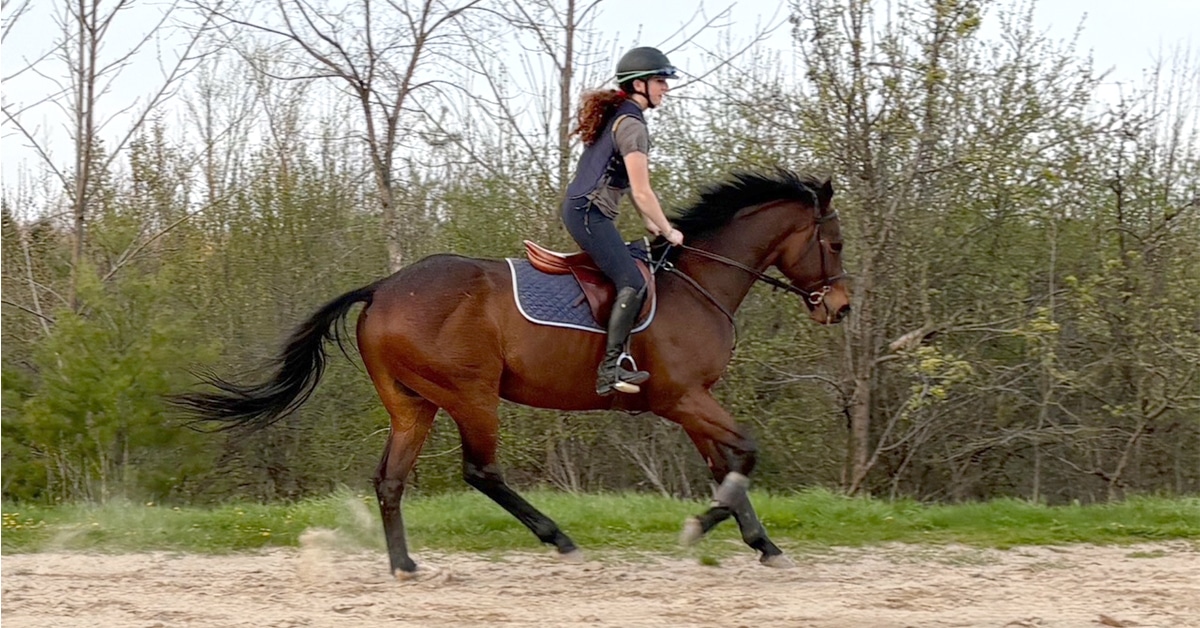
Kate Schaffenrath of She-Shoes Farrier Service. (Morgan Baumann photo)
Dr. Knoepfli emphasizes the importance of the hoof’s role in supporting and cushioning the horse through every stride. “The frog is important, because that is the pillow and cushion for the horse. If it is thrushy and soft, and you are asking the horse to do a lot of work, you are taking away a decent shock absorber. If it is too dry, too brittle, then that is a problem as well.”
He points out that no two feet are necessarily alike, even on the same horse. “They all have four different hooves and there are genetics to consider, seasonal changes, and also it depends on what work they are doing,” says Dr. Knoepfli.
Woodbine groom Alexa Wisnoski also stresses the importance of understanding how a horse’s individual hoof shape relates to its work and the surfaces on which it competes. “Turf horses need that plate foot” – a wider, flatter, more open-heeled hoof that skims across grass and stays on top of firmer turf, rather than digging deep into the ground. “The hoof shape can help decide which surface it will succeed on, or it will also determine the types of shoeing that you do, the types of angles that you do, and the type of care. Maybe they have really brittle feet, or maybe they need hoof oil. What one person might think is a bad foot might not be to someone else, because they have different knowledge of how to take care of the horse.”
Conformation and Footing
A horse’s natural conformation is one of the first considerations when developing an appropriate hoof-care program. The size and shape of the foot must be suitable for the horse, and individual variations can present challenges.
“The foot has to fit the horse,” says retired amateur jockey and broadcaster Renée Kierans. “Horses come with a variety of foot shapes and sizes, but it’s important that the feet match, especially in front. Also important is a foot that can support the size of the horse. A small foot on a big horse could be problematic.”
Some Thoroughbreds have particularly flat soles, which can leave them vulnerable to bruising. Long-time Woodbine blacksmith Guiseppe DeMartis explains, “You can’t change anything, but you can use a shoe with a pad to protect the sole.”
Kierans, who trained Thoroughbreds for nearly 40 years, notes that horses can also have significantly different feet on the same body. “One foot might be perfectly conformed, while the might be a club foot. As for how the horse travels with these feet, it’s what they know, so they adjust, and some are good race horses,” she says.
Footing is another important consideration. The surfaces horses train and compete on, as well as the routes they travel to and from the track, can contribute to bruising and other hoof problems. Kierans says stone dust can work its way into the hoof and contribute to abscesses and quarter cracks. And the problem is not necessarily limited to the galloping surface itself. “Getting to and from the track, especially during cold weather training, large stones can wreak havoc on the hoof sole.”
The degree of concussion also varies depending on the horse and the surface, says Kierans. “When the Woodbine main track was dirt, it had a stone dust base. Fort Erie’s base was clay and was always much kinder to the horses travelling over it. Clay seems to give back to the horses travelling over it, while stone dust doesn’t. With a heavy-hitting horse, the issues of bruising etc can be worse because of the greater concussion with every stride. With a horse that is light on its feet, there might be issues, but much less.”
Wisnoski points out that Woodbine’s Polyfibre surface presents its own considerations, particularly when temperatures drop. In colder conditions, the footing can become hard and lumpy, changing the way horses interact with the surface and causing kickback. The same horse may also respond differently to different training environments. “There are always the environmental stressors you need to pay attention to, such as [running on] polyfibre footing vs the dirt [footing] at the back sheds. Each horse is going to respond differently.”
Preventive Hoof Care
An effective hoof-care program extends beyond the farrier’s regular visits. Stable conditions, cleanliness, moisture management and nutrition all contribute to hoof health.
Wisnoski believes prevention is considerably easier than treating problems once they develop. “My mantra is ‘good foot, good horse.’ It is way easier to prevent injuries and any kind of bruises and cuts versus healing, because healing takes way longer.”
Keeping feet clean and dry is particularly important. Repeated exposure to moisture, followed by drying, can contribute to cracked heels and other problems.
“I have seen a lot of minor things that could be very easily preventable. If people are not washing off the feet after training and drying them properly, if they are not taking care of the cleanliness, horses will get cracked heels, and that is such a bothersome injury.”
DeMartis also identifies moisture as one of the major threats to hoof condition. Horses may be exposed to wet or oily track surfaces, while those standing in stalls can be affected by moisture from manure and urine. He says, “The foot absorbs so much moisture that they get soft,” and points to good stable management including using shavings to keep stalls drier, applying hoof oil to discourage moisture impermeability, and even hoof-targeted nutritional supplementation.
Mott agrees that nutrition is an important part of the overall program. “Good hoof supplements and an excellent feed program will help.” These are products that usually include biotin, amino acids, trace minerals (especially zinc and copper), and often omega fatty acids to support keratin production and hoof wall strength.
The frequency of trimming and shoeing must also be tailored to the individual. Some horses need attention every three weeks, while others can go longer. “Some horses may need shoeing every four weeks or less, some five or six weeks. There is no rule. I believe horses need to be done when they need to be done,” says DeMartis.
For racehorses, even relatively small differences in hoof balance can affect performance.
“We want that horse to go as fast as it can. Every stride of the horse has to be proper. If the feet are not properly trimmed, the horse will not reach its potential. If the horse is only striding five metres [16 feet] instead of six or seven metres [20+ feet], at the end of a race that will add up to two lengths.”
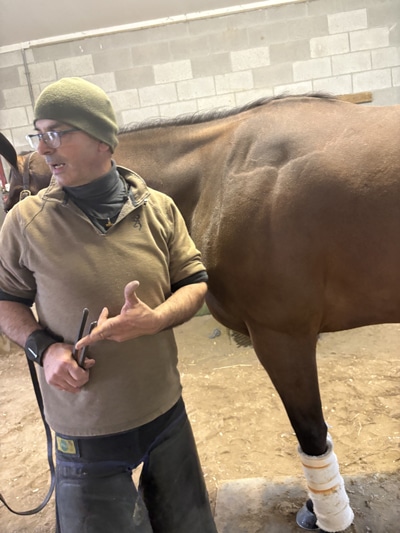
Farrier Guiseppe DeMartis. (Leslie Smith photo)
Losing shoes can also compromise hoof integrity, particularly when the same foot must be repeatedly rasped and nailed to replace them. “If a horse loses a shoe and you put it back on and you rasp again, you are taking more strength from that foot. Sometimes, when we don’t have any more hoof wall where we can nail the shoe, we can glue it,” says DeMartis.
Blacksmith Kate Schaffenrath, owner of She-Shoes Farrier Service, emphasizes that correcting hoof imbalances requires patience and a gradual approach. “A horse’s foot can be adjusted significantly to correct long term imbalances. To maintain the structural integrity, these changes must be done gradually, over 4-6 week trimming/shoeing cycles. Changing a hoof angle too rapidly can cause strain on tendons and ligaments.”
She also cautions against removing too much of the hoof’s protective structure. “Another important aspect is not to remove too much sole. It is the armour protecting the internal hoof structure. While addressing the outer wall within reason is acceptable, over-thinning/over-rasping the wall can weaken the hoof and could compromise the strength of the overall main weight-bearing structure.”
Finding the Right Balance
Ultimately, there is no such thing as a universally perfect Thoroughbred hoof. The goal is to maintain a healthy, balanced foot that can withstand the demands placed on it. DeMartis has seen how excessive toe length and poor balance can contribute to soreness and other problems, particularly in horses working at speed.
“We try to keep racehorses almost perfect, because when they gallop, they put on so much pressure. When you have a long toe, the lamina stretches and creates soreness, so there is less leverage.”
Schaffenrath has also observed that uneven or excessive loading can gradually change hoof shape. Left unaddressed, these changes may contribute to chronic lameness and internal structural damage.
For horses coming off the track and transitioning to another discipline, Mott says a period of downtime may provide an opportunity to reassess their feet and, where appropriate, allow them to go barefoot to toughen their soles.
Kierans also cautions against assuming that all Thoroughbreds have inherently weak feet that must always be shod. Different hoof shapes can be suited to different surfaces and disciplines, and management should reflect those differences.
Wisnoski agrees that racing itself does not necessarily mean a horse will develop poor feet. With knowledgeable management, appropriate farrier care and attention to environmental conditions, many problems can be prevented. “I don’t think that racing makes horses’ feet worse. It comes down to people having the knowledge to take care of them well and keep the hoof healthy.”
The Latest