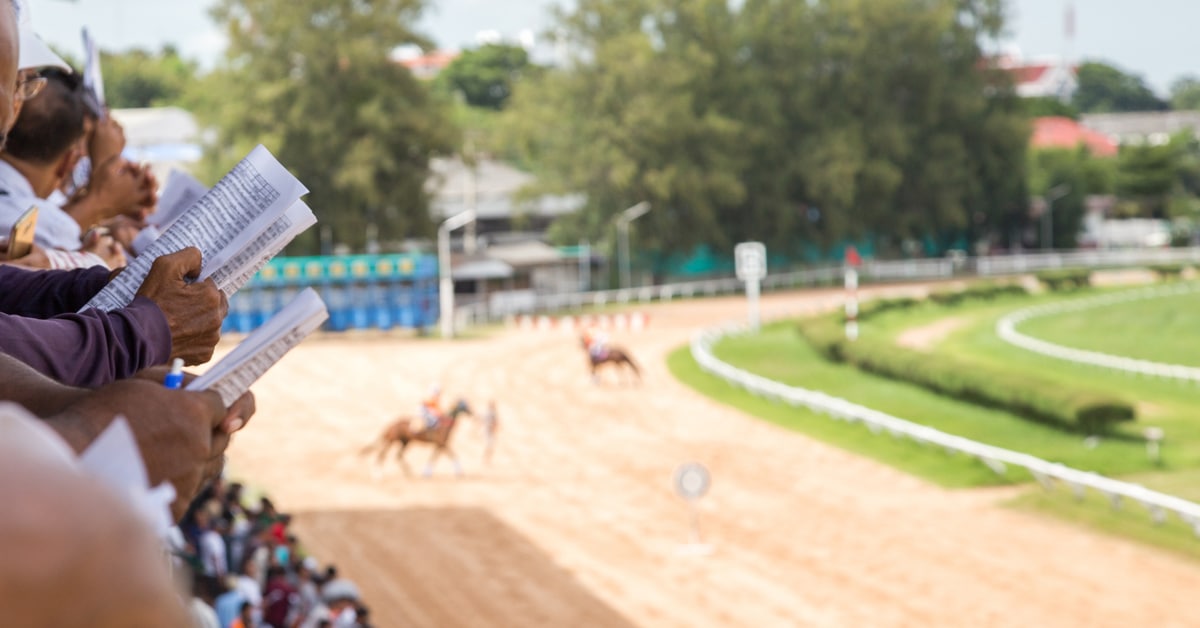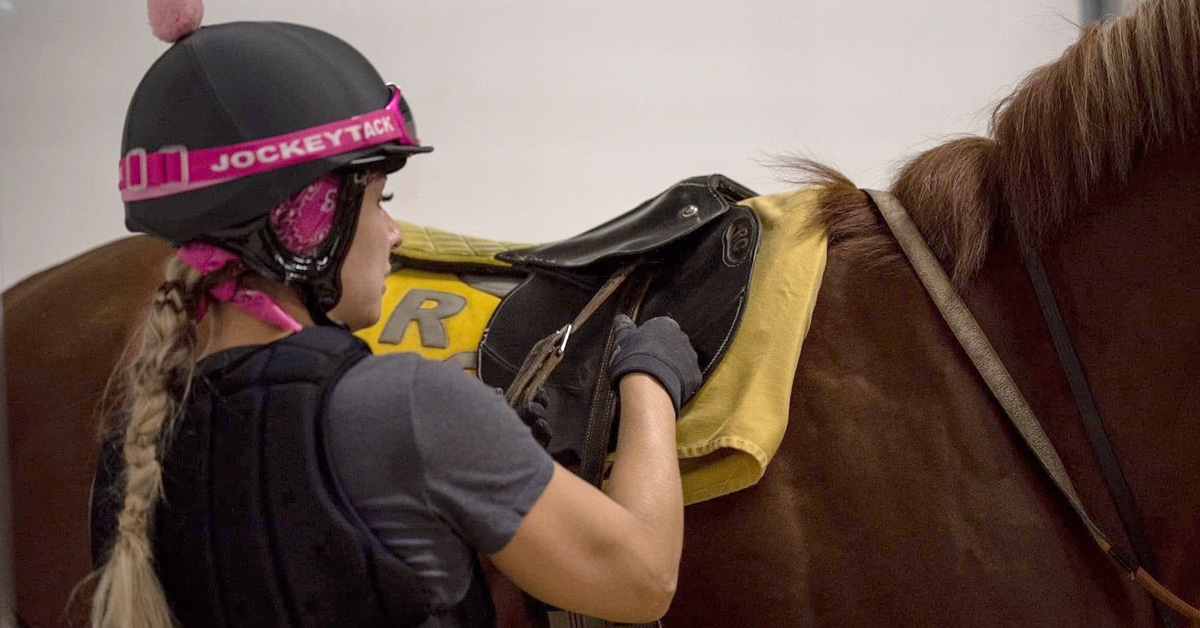
In the slate-black late night hours or morning darkness the sun still not even poking its head up; in the cold pouring rain or under a baking hot sun, horse racing’s backstretch workers toil in obscurity. Living behind the scenes – far removed from the spotlight – they feed, water, brush, rub, bathe, make and remake their horse’s straw beds, attending to every horse’s needs.
They are racing’s grooms – harness and thoroughbred – arriving before anyone else and still there long after everyone else has gone home.
When a horse wins the trainers and jockeys and drivers get the accolades; the grooms, sadly, get overlooked.
Until now.
Jodie Hiesinger was named the first recipient of the new Jockey Club of Canada’s Outstanding Western Canadian Backstretch Worker – a Thoroughbred award that partners with the longstanding Outstanding Groom Awards given to a groom working in Ontario. The award is sponsored by HBPA Alberta, Horse Racing Alberta, and CTHS, Alberta.
“It was kind of a surprise,” said Hiesinger, 34, who works for one of Alberta’s top Thoroughbred trainers, Rod Cone. “I knew Rod had nominated me, but I didn’t really think anything about it.
“I love what I do. It’s not really a job to me. It’s a way of life that I wouldn’t trade for anything.
“I always knew I wanted to work with animals and horses. It just came naturally. It was an easy thing to get into.”
If being given Western Canada’s Backstretch Award was a surprise to Hiesinger, it wasn’t to Cone.
“She’s amazing and so deserving,” said Cone. “She came to me 13 years ago as a groom and a gallop girl. Now she’s my assistant trainer. She does everything. She runs the barn. It’s hard to find an employee like her.”
While acknowledging that the backstretch workers rarely get the accolades, Cone said he would be lost without her and the other grooms that work for him.
“A trainer can’t win races without a good barn. The grooms do all the work. All the heavy lifting,” said Cone. “Ask any good trainer and they will all say the same thing. The trainers get the credit but it’s the barn workers who should get it.”
Born, raised and growing up in Edmonton, Hiesinger first started riding when she was 12 with a group of friends at Horse-Sense-Training. That’s all it took; Hiesinger was immediately smitten: head over heels with horses.
Two years later – 15 and still in high school – the passion burned hotter and she bought her first horse, Premium Port, for $2,000 from trainer Rod Heggie.
Retired from racing, Hiesinger retrained Premium Port to be a show horse and jumper. She also wound up working for Heggie for three summers.
Now 25, Premium Port is still alive and kicking, living out his days on a small acreage in Sherwood Park.
From 2009 to 2013, Hiesinger took five years away from the track working as an assistant manager in a video store. But she knew that wouldn’t be for long. She missed the horses she had fallen in love with.
“I wanted to be back with the horses,” said Hiesinger, who spoils all of her horses. “Lots of treats. Mints. Carrots. Sometimes apples. It depends on what they like.
“Horses like attention. A happy horse runs better.”
Unquestionably the biggest step Hiesinger took towards living her dream came in 2013 when, 22 at the time, she enrolled in the highly successful 15-week Horse Racing Alberta/Olds College Exercise Rider Program.
“That was it,” said Hiesinger. “I wasn’t going anywhere else.”
“I was told Jodie was one of the best students they’ve ever had,” said Cone, who has trained three Canadian Derby winners: Cozzy Grey in 1993, A Fleet’s Dancer in 1998, and Double Bear in 2017. That impressive list doesn’t even include Real Grace, who he trained to win the 2020 Derby for Shelley Brown, who was in an unforgiving battle with cancer.
“The Olds College asked if I had room for Jodie and I said ‘Sure,’ said Cone. “It was a great decision. It was amazing how this new girl picked things up and how efficient she was. She’s a really nice girl, too. She gets along with everyone. And she doesn’t cut any corners. She’s there for the horses.
“We treat her like family; like she was one of our kids. She calls me Gramps.
“That was thirteen years ago and she’s been with me ever since,” said Cone, who immediately gave her five Thoroughbreds to look after and gallop when he had a stable of 50 horses.
“She’s been a groom, an exercise rider, and now she’s my assistant trainer.”
When Hiesinger graduated from Olds College, she never thought about being a jockey. “I couldn’t make the weight and I like to eat what I want. I’m much happier being an assistant trainer.”
And she’s not sure about going out on her own as a trainer, either.
“I don’t think so. I’d rather work for somebody and gallop and pony horses, even though I’ve had my assistant trainer’s license since 2015.”
She did train one horse: Burning Up, who won one of just two starts before the owners sold her. So Hiesinger has a career .500 ‘batting average’ as a trainer.
Mints in her pockets as treats for the horses, Hiesinger arrives very early at the track – one of the first individuals to show up.
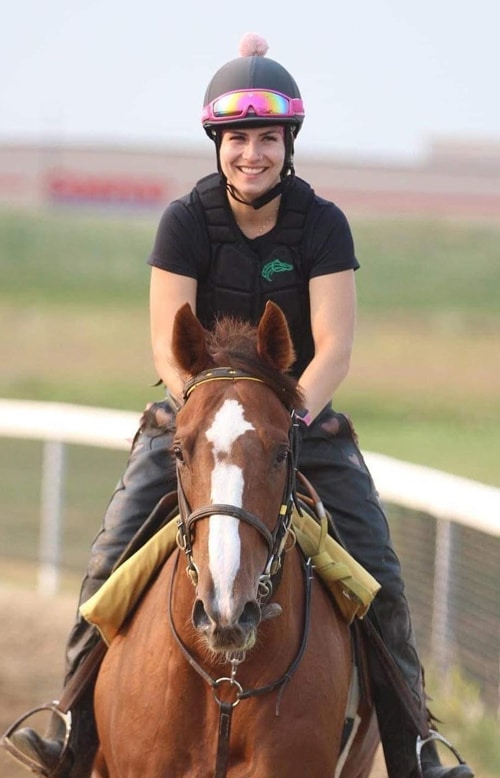
“Each horse has its own personality. It’s amazing how different they all are; you can’t treat them the same way.” (L.Turctotte Photo)
“I’m usually at the barn at 4 or 4:30 a.m.,” she said of being greeted by the nickering of Cone’s horses, who know that Hiesinger’s arrival means food is coming.
“The first thing I do is check all the horses and make sure everybody is good and they still have four shoes on,” said Hiesinger. “It’s amazing how they can lose a shoe at night.”
Then she feeds them an ample can of oats and makes sure there is plenty of hay to munch on.
“Then I putz around getting ready for the morning – brushing them and getting horses that are going to train, work, gallop or just walk on the walker or just around the barn ready. “I’m usually finished around noon.”
But the day is far from over.
These days, with winter refusing to pack its bags and go away, Hiesinger and the two other grooms employed by Cone take turns coming back for the horse’s evening dinner around 4:30 p.m. and to clean the stalls.
During the racing season on race days it’s a much longer day, of course. The horses trained by Cone – he currently has 13 horses in training with six more still to come into Century Mile – who are running are readied, and Hiesinger will pony those horses on post parade and to the starting gate. Even when Cone doesn’t have a horse entered, Hiesinger will pony seven or eight horses to the gate for other trainers.
Eight of Cone’s horses this year are two-year-olds.
“Lots of babies,” said Hiesinger. “It’s pretty early – the two-year-olds are just figuring out what they are doing – but I like a couple of them.”
Another Cone-trained horse is Hiway Forty Nine, who, with two stakes wins last year, is a finalist for owner Al Pitchko as champion Two-Year-Old Filly of the Year.
“She looks great,” said Hiesinger. “She grew a bit and is eager to train.”
All the thoroughbred winners will be announced May 1 at the Night of Champions.
Sometimes Hiesinger isn’t finished on race days until very late at night. Then she’ll go home, get four short hours of sleep and start all over again the next day.
“Those days are long, but I still love it,” said Hiesinger, who is constantly talking to the horses.
“It’s a lifestyle. It’s definitely not for everyone. My parents were surprised when I told them what I wanted to do with my life. But they were very supportive.”
It can be a dangerous job in an often perilous sport. On May 4, 2024, a pony named Omar flipped over on her on the track after the final race on the card. Hiesinger broke 10 bones, including her left ankle, which required three surgeries, nine screws and a plate, and broke her left shoulder and seven ribs on her right side.
“I don’t know if something scared him, if he was bitten by a bug, or what happened. He went up and I went down. I tried to get away from him, but he knocked me over, rolled over me and then calmly got up and walked away.”
Hiesinger was out all of 2024 and was still in pain last year and some discomfort this year. “It’s harder for me to gallop horses. There’s no flexion in that ankle.
“I had never broken anything before. I went all out that time.”
Hiesinger knew the accident was an aberration and bought Omar, 13, who is still at the track as a pony.
Quitting and after that accident didn’t enter her mind.
“Never,” said Hiesinger, who, if she isn’t busy enough, is also the Horsemens Benevolent and Protective Association’s new Backstretch Coordinator.
“I just love my life and love my horses. Each horse has its own personality. It’s amazing how different they all are; you can’t treat them the same way. They are all so smart. They’re a lot smarter than people think.
“Most days you see why you do it. And if you’re having a bad day, the next day will be different.
“I have no idea what I’d do if there wasn’t any racing. I’d be lost.”
The Latest