Safety and performance of equine sport surfaces have been hotly debated, especially in Thoroughbred racing. This discussion is complicated by the fact that risks to the horse and rider are multi-factorial. A perfectly sound horse is unlikely to be injured even on an imperfect racetrack. However, horses with pre-existing injuries may be placed at higher risk by any inconsistencies in the racing surface.
While a consistent surface also allows trainers, riders and owners to more easily assess the conditioning of the horse and reduce the time required to adapt to a new surface, the safety of the horse and rider is the first priority. Standardization of data collection and testing make it possible to collect the long-term data required to understand the role of the multiple factors that contribute to safety. Placing an emphasis on consistency, both spatial and temporal, is a pragmatic way to acquire data at the large scale required to assess safety. However, it is critical that measurements are made with standard methods and documented in a manner that allows the resulting large data set to be used to develop safer racing surfaces. In the meantime, enhancing the fairness of the track, and perhaps eventually the safety, has been possible at individual racetracks and is now making it possible to reduce variability between tracks within a region.
The specific racetrack characteristics that are being measured determine how frequently testing needs to be performed. Evaluation can be divided into three testing categories: low frequency, medium frequency and high frequency. Track design is a long-term characteristic that does not require frequent evaluation (low frequency) and includes turn radius, turf species, turf profile and the materials selected for dirt or synthetic materials selected for the local climate. Medium frequency testing is required for characteristics that should be measured on a yearly or semi-annual basis and include material segregation, wear and contamination of the surface, damage to the base, formation of a consistent hardpan layer, compaction of turf or separation and compaction in a synthetic surface. Daily testing (high frequency) is required for characteristics that may change daily, or even hourly, including moisture content on dirt or turf surfaces, divots in turf, cushion depth on dirt and synthetic and temperature of a synthetic surface. All of these factors change the hoof surface interaction and potentially influence the safety of the horse and rider.
Accurate information about the track design is not always readily available. Racetracks with recent renovations may have engineering drawings with data such as turn banking and crossfall. For many of the tracks, design information requires surveying the base or compacted cushion to understand the original track design. Turf tracks present additional issues since even surveys may not represent the original design due to changes from compaction and top dressing. Furthermore, historic track information on material composition can be unreliable since different laboratories use testing protocols borrowed from a range of industries and applications, including civil engineering, agriculture and even metal casting. For Thoroughbred racetracks, consistent testing based on standard methods has now been available for three years. Composition targets are now based on multiple years of data, and the potential exists to gradually introduce modifications to more closely align the response of racetracks within a region.
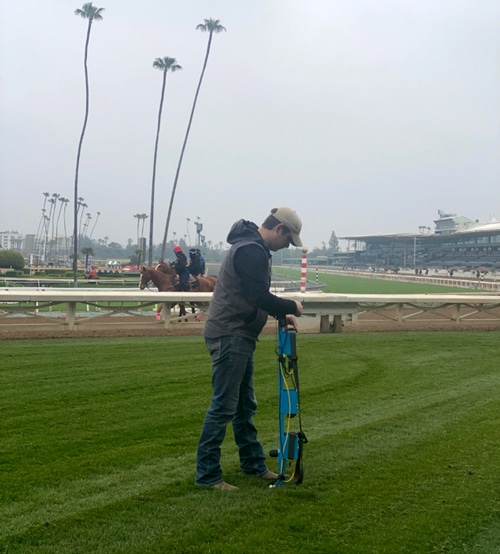
Turf being tested with a penetrometer. (Photo courtesy Racing Surfaces Testing Laboratory)
Nearly all North American tracks now conduct annual or semi-annual (medium frequency) testing*. This testing originated with a 2008 study supported by Churchill Downs Incorporated which included biomechanical surface testing, which simulates the hoof loading from the forelimb of a Thoroughbred at a gallop and ground penetrating radar. This effort was expanded in 2020 when The Jockey Club provided funding to build and purchase sufficient testing equipment to assess all of the North American Thoroughbred racetrack surfaces. For racetracks covered by the Horseracing Integrity and Safety Authority (HISA), the cost of testing was funded by HISA to facilitate compliance with federal regulations. Characteristics of the track that are assessed include base inconsistencies, radial and circumferential depth variation, material inconsistencies and inconsistent harrowing and grading. Changes to the profile or areas of differential compaction are also evaluated in turf, dirt or synthetic materials by using biomechanical surface testing, ground penetrating radar and composition testing based on seven standard samples from each track. All testing is done prior to race meets so that sufficient time is available to identify causes of variation and assist local experts in correcting the problems.
The high frequency data, (track characteristics that can change on a daily or even hourly basis), are the most challenging to monitor. Weather stations installed at many of the tracks are supplemented by a weather service that provides hyperlocal weather estimates for the racetracks. The racetracks also take daily measurements of cushion depth and moisture on dirt tracks after training and before racing. For turf surfaces, measurement includes the penetration of a probe pressed by a mass into the surface and moisture. For synthetic tracks, the measurement of surface temperature and depth of the cushion are obtained. Currently, most of the tracks manually enter this data into the database. Automation of the data upload to the database and more precise measurement of cushion depth have recently been used by some of the tracks to improve the accuracy of the data and reduce the time required for testing.
All three data sets, low, medium and high frequency, are integrated into a single relational database for analysis and reporting of the data to HISA. The Maintenance Quality System (MQS) was introduced in 2014 as a way to describe the overall approach to racetrack measurement and reporting for consistency. The MQS introduced the standard testing methods and maintenance equipment tracking along with a database to compile the information for analysis. In the longer term, meaningful analysis of surface data will require that other factors, including race conditions, veterinary treatments and other horse level conditions, are included in the analysis.
This is an exciting time in Thoroughbred racing. As a result of the new federal regulations and broad industry cooperation, we are approaching a point in the future where we may be able to say, “This is a safe track.”
~ Michael Peterson, PhD
Professor, Biosystems and Agricultural Engineering
University of Kentucky
***
*At Woodbine Racetrack, track testing and maintenance occur on overlapping schedules to ensure safety and consistent racing conditions, consisting of race day and between-race inspections, weekly walks, 10′ checks and regular surface quality monitoring. Woodbine’s Director of Racing Surfaces produces daily maintenance reports for all surfaces (Tapeta, E.P. Taylor Turf Course and Inner Turf Course), which can be found here.
The Latest