Just one year after racing stewards across the country handed down a record 441 total rulings, the message may be getting through.
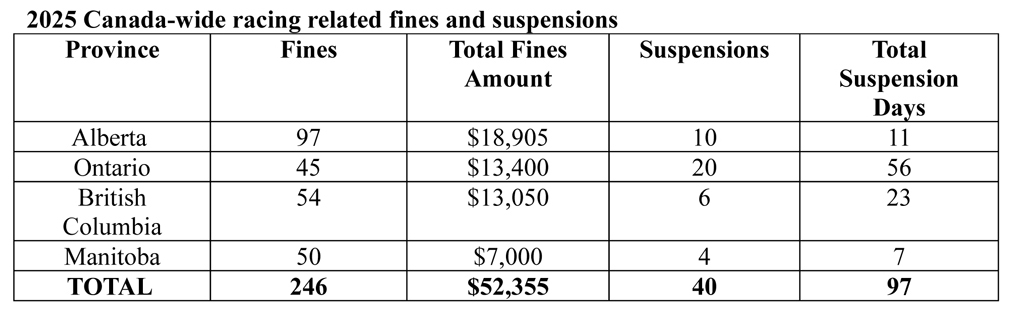
A widely-accepted principle of sport is that good governance is critical to ensure fair play, safety, and transparency. As a result of this, the total number of fines and suspensions in 2025 across Canada’s five major racetracks in four provinces dropped by almost 37% (279 total) compared to 2024.
Jockeys and trainers made up the majority of 246 racing-related monetary penalties totalling $52,355 in fines and 40 suspensions adding up to 97 days (some rulings included both a fine and suspension).
Jockey infractions
Perhaps the most bizarre ruling of the year came from British Columbia’s Hastings Racecourse on July 12. Jockey Antonio Reyes, riding Set to Shine on the card’s second race, was handed a $500 fine and 15-day suspension for “Misuse of his riding crop by striking another rider and horse during a race.”
Reyes and Set to Shine went head-to-head with second choice Stanford Bay and jockey Kerron Khelawan for the majority of the race, with the two horses opening up seven lengths on the field through quick opening splits of 22.3 and 45.1. At the top of the stretch, Set to Shine began to weaken, and with half a furlong to go, Reyes reached across his body and struck Mr Morris and jockey Silvino Morales, who had come off the rail on Set to Shine’s inside. Watch the replay here:
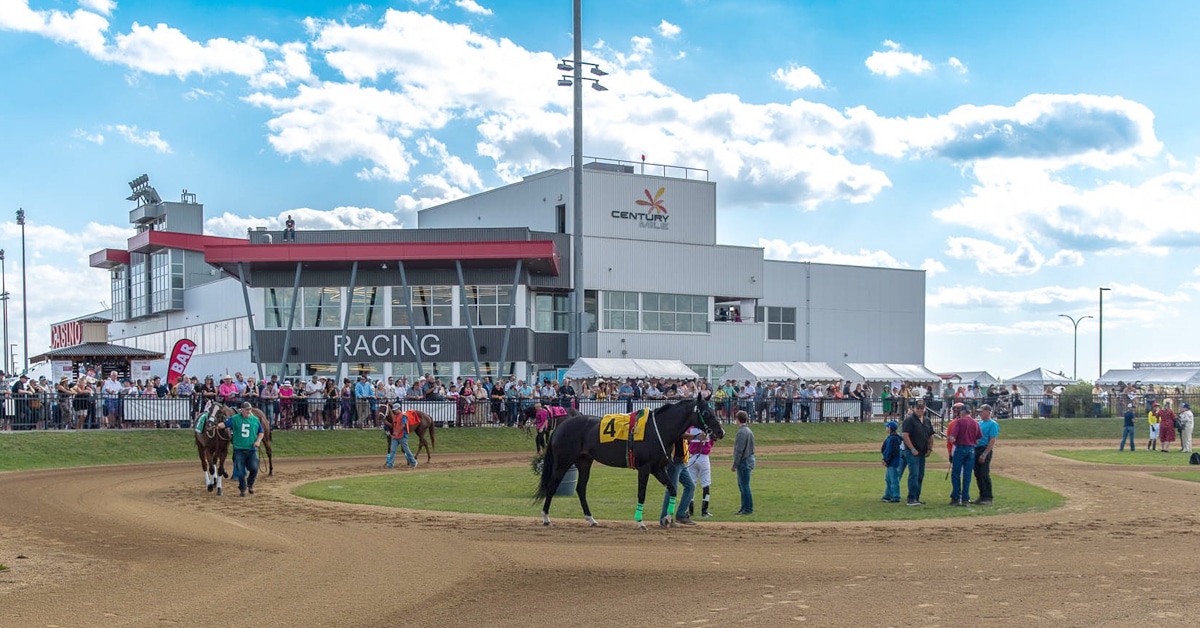
This was one of 82 whipping violations jockeys were reprimanded for in 2025, ironically the same number to have taken place at Alberta’s Century Mile alone one year prior. Despite the province having scheduled only one third the total number of racing days (56) as Ontario (168), Century Mile and Century Downs combined to have four times the number of whip infractions (44) as Woodbine and Fort Erie Racetracks (11).
While whipping rules differ by province, all adopt the same principle, requiring jockeys to keep their whips below the shoulder when urging their mounts. Ontario allows three strikes with the whip, followed by a pause to allow a horse to respond before subsequent whipping. Alberta allows a maximum of six hits total during a race; Manitoba and British Columbia permit 10.
The majority of Alberta’s whipping fines were for excess number of strikes, averaging $100 per violation and going up with additional offences. Two jockeys, Keihton Infante and Dane Nelson, were each handed one-day suspensions at Century Downs in October following their fifth respective excessive whipping violations of the year. Such penalties were less common at Woodbine; however, jockey Rico Walcott did suffer the stiffest whipping penalty of the year when he was cited a $1,000 fine (20% of earnings) for “Urging his horse in an excessive manner,” when riding Scat Girl to a second-place finish in the Wonder Where Stakes on September 6.
In a heartbreaking announcement on December 5, Hastings Racecourse’s operator Great Canadian Entertainment announced it would no longer conduct Thoroughbred racing, effectively marking 2025 as the final season of 133 at the historic British Columbia track. While the city of Vancouver owns the land which Hastings sits upon, Great Canadian cited a lack of economic feasibility due to the provincial government cancelling the agreement to share slot machine revenue which supplemented racing purses.
Operating the only Thoroughbred racetrack in the province, Hastings led all Canadian racing jurisdictions in number of interference offences with 24, followed by 15 in Ontario. Alberta and Manitoba each totalled 13. Although most of the 24 were met with fines starting at $100 and going up depending on severity, only three led to suspensions, ranging between one and three days.
The worst such offence occurred during the running of the fifth race on October 4. Jockey Kerron Khelawan, riding Diocles, caused interference to the horse on his inside, leading to an accident and the race being declared no contest. Khelawan received a two-day suspension, with the stewards adding a third for the incident being his second such interference infraction within a month.
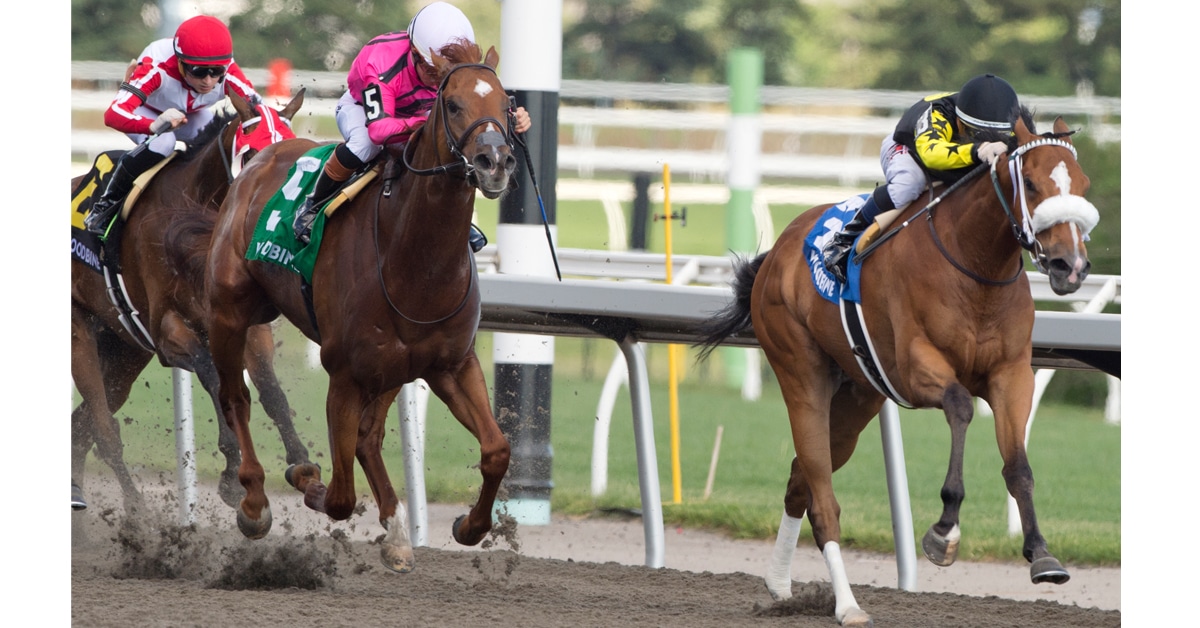
Ontario, known to levy more suspension days than fines for interference, handed out its longest such penalty of the year for an incident in the fourth race at Woodbine on November 28. Canada’s Outstanding Apprentice jockey of 2022, Slade Jones, was handed a seven-day suspension for what was deemed careless riding during the run around the far turn, causing an accident.
Jockey Eswan Flores was cited on consecutive days for interference, coming out on a rival when guiding The Great Oz in Woodbine’s eighth race on November 14, and dropping in on a rival the following day during the tenth race aboard Lucky Score. Both instances carried with them three-day suspensions and were Flores’ sixth and seventh rulings of the year, to go with four $200 fines for failing to persevere with his mount and one excessive whipping violation, good for a $300 fine and one-day suspension.
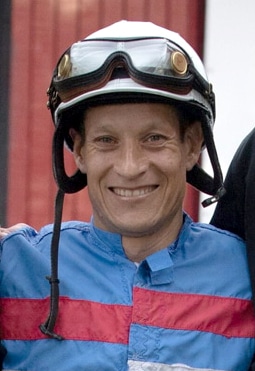
Amadeo Perez was again leading jockey at Hastings Racecourse in 2025, but had the highest fine total of any jockey in the past year – $2,300. (Michael Bye photo)
Overall, the jockey with the most trips to the stewards’ office across Canada in 2025 was Richard Balgobin. Riding at Hastings Racecourse, Balgobin was fined on ten occasions, five times for excessive whipping, four times for interference and failure to maintain a straight course, and once for failure to persevere with his mount, all totalling $1,900 ‒ but he did manage to escape even a single day of suspension.
Much like Balgobin, fellow Hastings jockey Amadeo Perez also avoided suspension in 2025, and even stood before the stewards on four less occasions than Balgobin, but it was the severity of his infractions that led him to have the highest fine total of any jockey in the past year. After three excessive whipping violations in 16 days cost Perez $300, he would also rack up three interference fines from August 9 to September 13, with escalating amounts due to multiple interference infractions coming within a two-month period.
The penalties of $250, $750, and $1,000 hurt all the more considering the three disqualifications they were the result of cost his mounts a win and two seconds, bringing his total fines on the year to $2,300, 27% of all jockey fines handed down in the province last year.
Trainer trip-ups
Trainers across the country were certainly not exempt from incurring the stewards’ wrath in 2025, with 98 of the 279 total racing related rulings handed down to conditioners. The most common infraction? Entering an ineligible horse to race.
Trainers were fined 23 times during the year for entering a horse the either didn’t meet the conditions of the race, didn’t have the proper workouts required to qualify them, didn’t have gate approval, and in two instances horses were scratched for “not being properly conditioned to race.” Alberta trainers led the way with 14 such fines, Manitoba followed with five, Ontario three, and British Columbia with just one.
Each infraction occurring in Alberta, Manitoba and BC carried with it a $100 fine, whereas in Ontario, two such cases cost $200 and one $300.
Disturbing the peace, unprofessional conduct and altercation fines were especially prevalent in Alberta this past year, with 10 such cases drawing the ire of racing officials. Stewards at the province’s two racetracks handed out fines of $100 and $250, depending on the incident, and once again required the completion of a “Respect in the workplace” online course within 14 days of the incident.
In Ontario, trainer Harold Ladouceur twice found himself guilty of disturbing the peace and showing disrespect towards a racing official, once following the running of the eighth race at Woodbine Racetrack on July 25 and the other for misconduct toward an official in the race office on August 20. The two instances resulted in $1,000 and $200 fines, respectively.
When being ‘positive’ is a bad thing
Three positive tests following races were recorded in 2025, two in British Columbia and one in Ontario.
Parker Point, trained by Harold Barroby, finished first in the eighth race at Hastings on September 13 and subsequently tested positive for Dantrolene, a skeletal muscle relaxant. Parker Point was disqualified from the win and Barroby was fined $1,250. A week later, the Nicole Rycroft trainee Curlin Rocks won the fourth race at Hastings on September 21, but tested positive for Flunixin, a non-steroidal anti-inflammatory (NSAID) drug, resulting in a disqualification and $1,250 fine for Rycroft.
Earlier in the year, Party On, trained by Kevin Attard, tested positive for Arquel, an NSAID, following a win at Woodbine on April 26. Party On was disqualified and Attard fined $500 and given a three-day suspension.
Another medication-related positive came at Woodbine on November 9 when the Marty Drexler trainee Armstrong tested positive for the NSAID Bute following a morning workout. Drexler was handed a $500 fine, as horses working out in order to be removed from the vet’s list must not have any such medications in their system.
All told, trainers accounted for $21,900 (or approximately 42%) of the $52,355 in fines that were collected by the sport’s governing bodies across the country.
These rulings ensure the sport continues to operate in the best interest of fairness and safety for all involved and above all else, the health and well-being of the Thoroughbred athletes at its forefront. And with the Canadian Thoroughbred racing landscape shrinking by one track and province this year, one would expect that the 2026 list of fines and suspensions should only get smaller.
But with many months of racing ahead, races and purses to be won, only time will tell.
The Latest