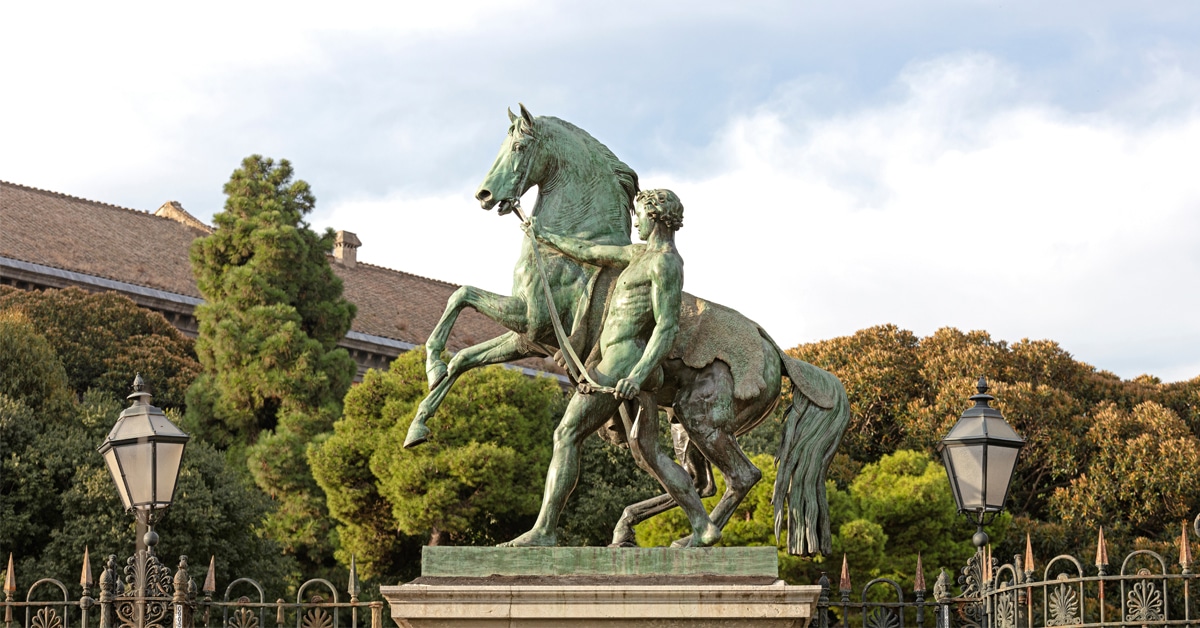
There is perhaps no profession that has remained as remarkably unchanged throughout history as that of the horse groom. Once humans domesticated horses around 3500 to 4000 BCE, dedicated caretakers became necessary for feeding, managing, and training them for transport and warfare. Ancient empires, including Egyptian pharaohs such as Ramses II, maintained massive stables, and ancient Assyrian reliefs dating back to the 1st millennium BCE clearly show grooms tending to horses.
So many of the daily practices that modern grooms utilize to ensure their horses are healthy, fit, and looking their best have been around since the Middle Ages, or even earlier.
Tracking down first-hand accounts of a groom’s typical day is challenging, primarily because stable staff were rarely literate. What we do know comes instead from the meticulous records of head trainers and stable masters. Among the most famous accounts are the 1602 treatises of Pirro Antonio and the records of Count Bentivoglio, who managed a prominent racing outfit in the 1500s.
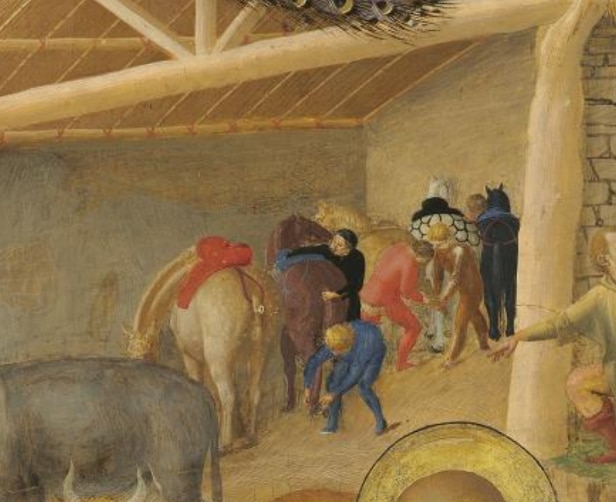
Detail of grooms and horses from ‘The Adoration of the Magi’ / c. 1440/1460 / Fra Angelico and Fra Filippo Lippi, (Courtesy National Gallery of Art, Washington)
In these historic stables, the lives of the grooms were given over entirely to their charges. Both stable masters maintained an all-male staff, and entering their service meant forfeiting any semblance of a traditional family life. The young boys under employment lived in the barns day in and day out, sleeping directly next to their horses.
Limiting each groom’s responsibility to only three or four horses ensured that every animal received concentrated attention. Having the grooms sleep alongside their charges allowed for immediate care if a horse fell ill overnight, but it was also a vital security measure. Well-conditioned war horses or elite racers could be prime targets for theft or poisoning by rival stables, making the groom part of the first line of defense.
This round-the-clock dedication was fiercely guarded by stable masters like Antonio. As head groom and stable master, Antonio was entirely in charge of hiring and firing. In his treatise, he notes with blunt honesty that he fully intended to be both “feared and loved” by those who worked under him. He expected his grooms to work willingly, driven by a genuine love for the job, and he famously tolerated no idle hands.
This strict management extended to an extreme obsession with cleanliness, a dictate that mandated the stalls, stable block, and even the outer walls of the facility were to always be kept immaculate. Antonio also insisted that if a horse was taken into public streets, it had to be flawlessly tuned out, featuring ribbons woven into the mane to match the colour of its halter. These high standards of pride in workmanship are traits that any modern groom today would instantly recognize.
Beyond these high standards of presentation, the daily routines of these Renaissance grooms mirror modern backside track life down to some very finite details. In Bentivoglio’s 16th-century stables, the morning routines began by tying the horse to the wall, brushing the coat until it gleamed, mucking out the stall, tacking up for the rider, and assisting the rider with mounting. After the horse was worked, the groom would throw a light blanket over the horse and walk it until it was properly cooled down before administering a bath. Bentivogio is referencing the time-honoured practice now known as hot-walking.
Even the tools used by grooms have defied the passage of time. Historical promotional pieces, such as an early illustrated poster for a stable in Austria, depict grooming kits that can still be found in almost any modern barn: sponges, rub rags, curry combs, and the classic three-prong pitchfork.
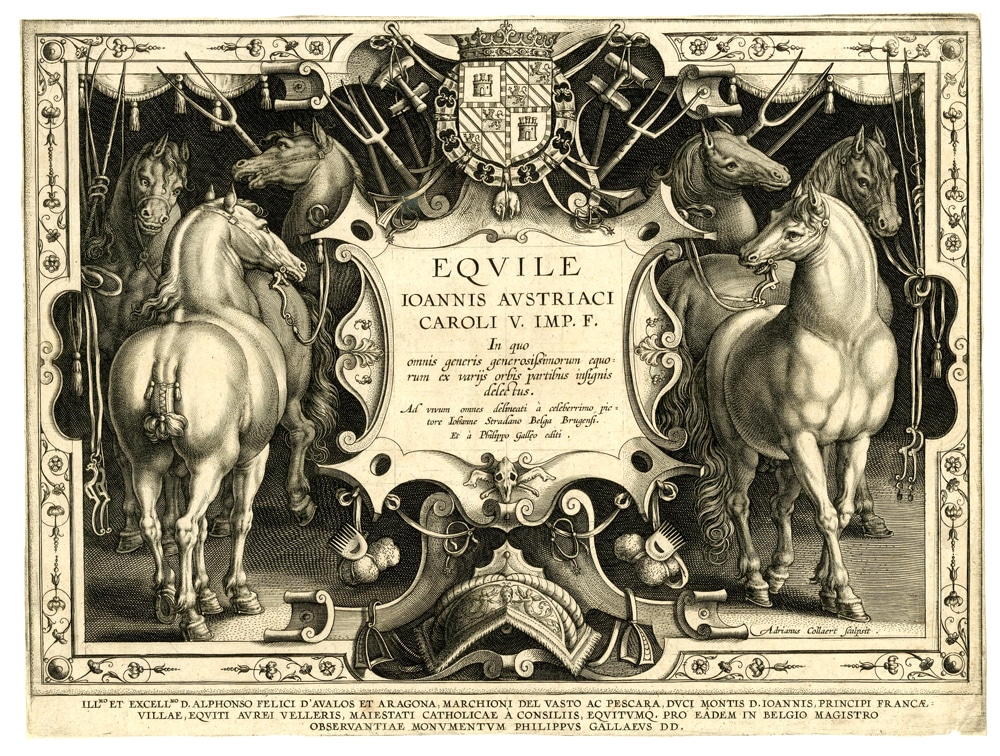
Title plate to ‘The Stable of Don John of Austria’ depicting grooming tools. (©The Trustees of the British Museum. CC BY-NC-SA 4.0 licence.)
Beyond the shared daily chores, the two eras also share the unique economic realities of the profession. Grooms received a formal wage for their laboor. In Renaissance Italy, a groom might earn five scudi a year, which translates to around $75-100 today – a meager sum heavily contrasted by the immense value of the horse they protected.
With such minimalist wages, gambling was also a common fixture of stable culture. Bentivoglio complained on multiple occasions that his grooms were often distracted by wagering. He routinely criticized the behaviour, noting that it left the boys exhausted when they were supposed to be alert and caring for the horses.
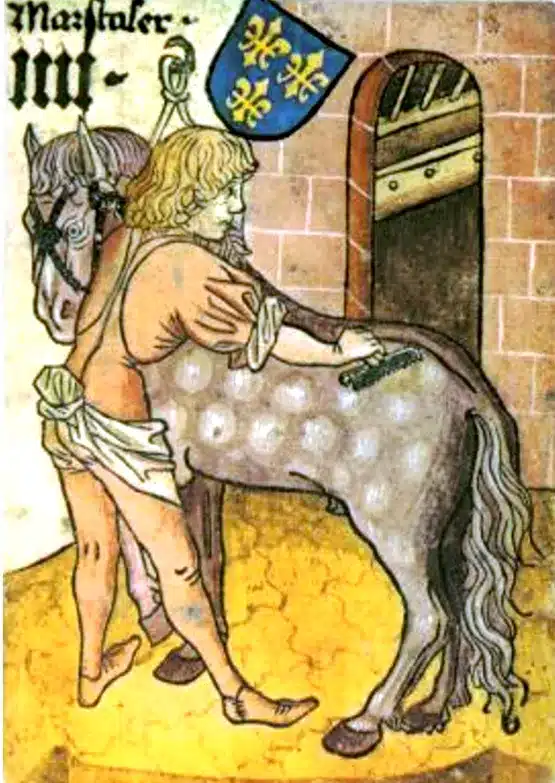
A playing card from France (c. 1400 – 1500) showing a groom currying a horse.
This lively interest in the sport’s outcomes and the occasional casual wager remains a traditional pastime. It is hard to pinpoint the exact moment the first horse racing bet was placed; gambling was a popular leisure activity in the Middle Ages. We know the first horse race for a purse was established by King Richard I of England (the famous Richard the Lionheart), who offered a prize of four pounds for a three-kilometer race. King Richard also implemented strict gambling laws prohibiting anyone below the rank of knight from placing a wager.
Consequently, any groom indulging in a bet was doing so illegally. While official records of these illicit wagers are scarce, given there was hardly a tavern or shipyard in the medieval world where dice weren’t rolling, it would be a safe bet to assume the stable hands were involved.
The career of the stable hand is one of the world’s oldest professions. Today, it is estimated that there are 60+ million horses in the world, with the number of grooms working across racing, breeding, riding schools, and in private stables is believed to be in the hundreds of thousands, or even low millions.
Ultimately, when looking back at the life of a groom in the medieval and Renaissance worlds, it becomes clear just how much the simplest act of caring for our horses’ well-being has remained the same. Even centuries later, the heart of the industry still follows Bentivoglio’s timeless advice to his grooms: to work willingly, and always “with love.”
The Latest