High stud fees are known to correlate with higher sale prices. In a bull market, this can mean harvesting big gains, but in a bear market the chance of breaking even or maybe even getting a decent return on the investment is higher. If your primary strategy is to breed the most proven mare you have to the most fashionable stallion you can afford — read on.
Correlation of Stud Fee With Race Ability
Using the BloodHorse’s Top 150 list of North American Stallions by progeny earnings, a simple plot of the stud fee vs. the average earnings of the offspring yields a graph that hardly shows any correlation.
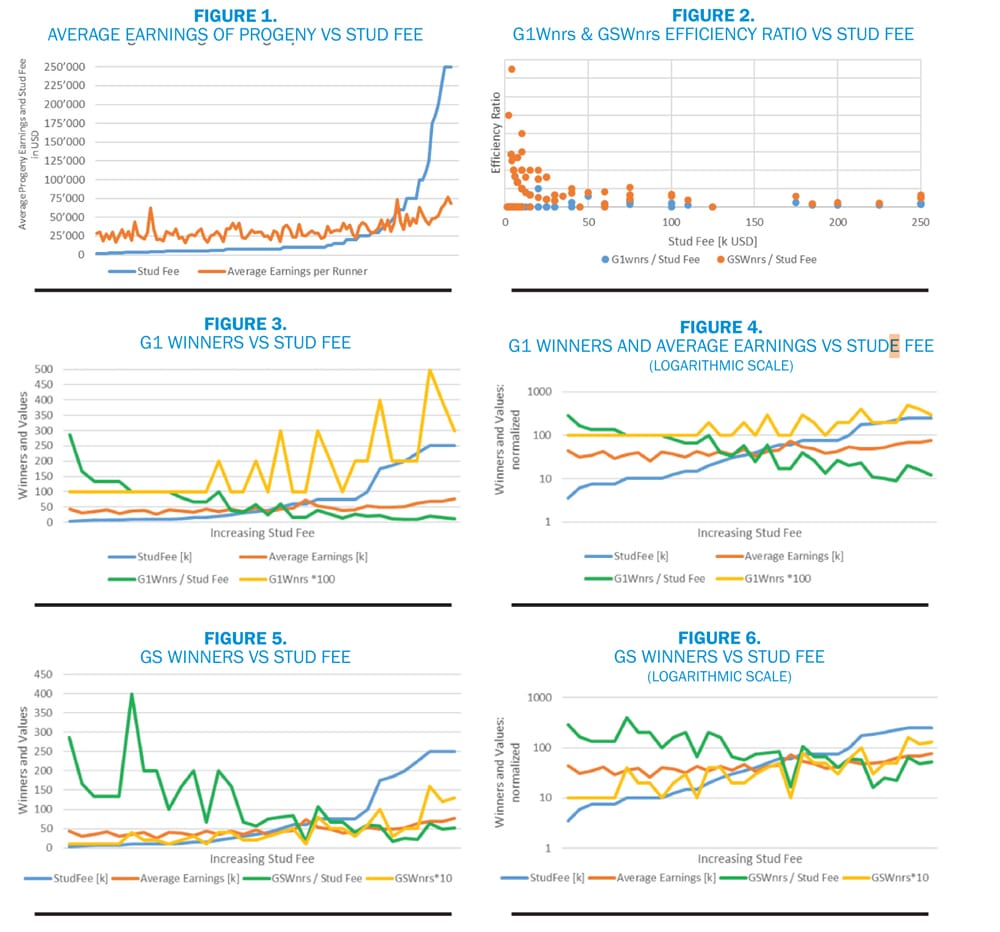
Figure 1 shows a peak in average earnings at low stud fees and statistically higher earnings at the high end of stud fees. Since the chart uses average earnings of progeny rather than the median which would remove the highest and lowest earners, a single high-earning runner from a modestly-priced sire can create a peak that does not reflect the true centre of his offspring’s earnings.
To measure the value return on stud fees (success per dollar), I created efficiency ratios by dividing the number of G1 winners and Graded Stakes winners by the stud fee, then analyzed how these ratios are distributed along increasing stud fees.
Let’s compare Valiant Minister and Into Mischief. The plot visualizes that for every dollar you spend, a cheaper stallion like Valiant Minister has (so far) generated more than 10 times the number of G1 winners as an expensive stallion like Into Mischief. This number broken down to a single stallion is statistically not significant as neither 1 nor 5 winners are statistically significant, but the plot shows a trend: spending more money does not buy you proportionally more success in producing winners. It buys you other things: a higher probability of success (as shown in Figures 3 & 4), commercial appeal, and a proven track record. But if your primary goal is to breed a racehorse and maximize your return on the stud fee investment, the data shows the most efficient hunting ground is in the lower fee brackets.
Valiant Minister
– 1 GSWrs + 1 G1Wnrs = 2 / $3500 stud fee = .00057
Into Mischief
– 17 GSWrs + 5 G1Wnrs = 22 / $250,000 stud fee = .000088
Figure 2 plots this efficiency ratio against rising stud fees along. It clearly reveals that the number of GSWnrs per dollar invested is highest in the lower stud fee segment, illustrating the real potential in breeding to a well-chosen, modestly-priced stallion.
This plot also emphasizes the potential of the art of breeding: to aim for a performer, it is not the sheer amount of dollars invested that counts, but the knowledge and experience to chose the right mate for your mare. Here, the power of nicks and the skillful composition of a pedigree come into play.
How to Breed a Unicorn
The highest public acknowledgment is earned by the G1 winners and their connections. The picture with G1wnrs seems more complicated, though. Many stallions haven’t (yet) produced a G1 winner, so let’s specifically look at those that did produce at least one G1 winner (32/150 = roughly 20%).
The following plots reveal two key trends: higher stud fees correlate with an increased likelihood of siring a G1 winner, and average earnings per runner rise modestly as stud fees increase.
Figure 4 uses a logarithmic scale plots data over a wide range of values which makes it useful for visualizing data with vast differences in magnitude such as stud fees. The logarithmic plot clarifies the relationship between G1 winners and stud fees and also highlights an important efficiency trade off: The green line illustrates that the value “winners per stud fee dollar” actually declines as stud fees rise. The return on investment at the top end of the market is less likely to result from a G1 winner and more likely to result from a higher sale price.
However, if the goal is to breed specifically for a G1 winner, there are three stud fee categories to consider: up to $15 k, where studs produced at most one G1 winners (by genetic ability or chance). From $20 k – $75k, where studs produced between one and three G1 winners. All studs in the dataset with stud fees above $100 k produced at least two G1 winners. Into Mischief (2005) is leading the pack with five G1 winners and a stud fee of $250 k. Gun Runner (2013) and Not This Time (2014) being almost ten years younger but with the same stud fee of $250 k, are following with four and three G1 winners, respectively.
This consistency at the top tier also reflects elite mare books and the commercial pressure that filters toward genetically proven, physically superior matings.
(Sidenote regarding Figures 3, 4, 5 and 6: Please note that to account for the relatively limited number of GSWnrs and G1 winners, in the plots below the number of GSWnrs was multiplied by 10 while the G1Wnrs in the plots above were multiplied with 100. This factor has been arbitrarily chosen to improve visibility of the data.)
Chances For a Graded Stakes Winner
By aiming at a unicorn, how likely is it to end up with a successful Graded Stakes winner?
Figures 5 and 6 show the strategic insight that the likelihood of siring a Graded Stake winner (G2 or G3) correlates much less with an increase in stud fees than siring a G1 winner does. Visually, this is shown by the flatter, more volatile trend line for GSWnrs compared to the steeper climb for G1wnrs, and also the efficiency ratio (success per stud fee dollar) is far more volatile for GSWnrs than for G1wnrs. This volatility underscores an important reality: comparable success for breeding GSWnrs can be achieved with low- to moderate-budget stallions, provided the breeder selects the right mate and observes nicking and pedigree patterns.
Putting The Pieces Together
The above correlations are revealing, as many commercial and private breeders focus on the $25,000-and-under segment, aiming at breeding the best possible foal within a realistic budget. Before we look at this segment specifically, let’s summarize the key findings so far:
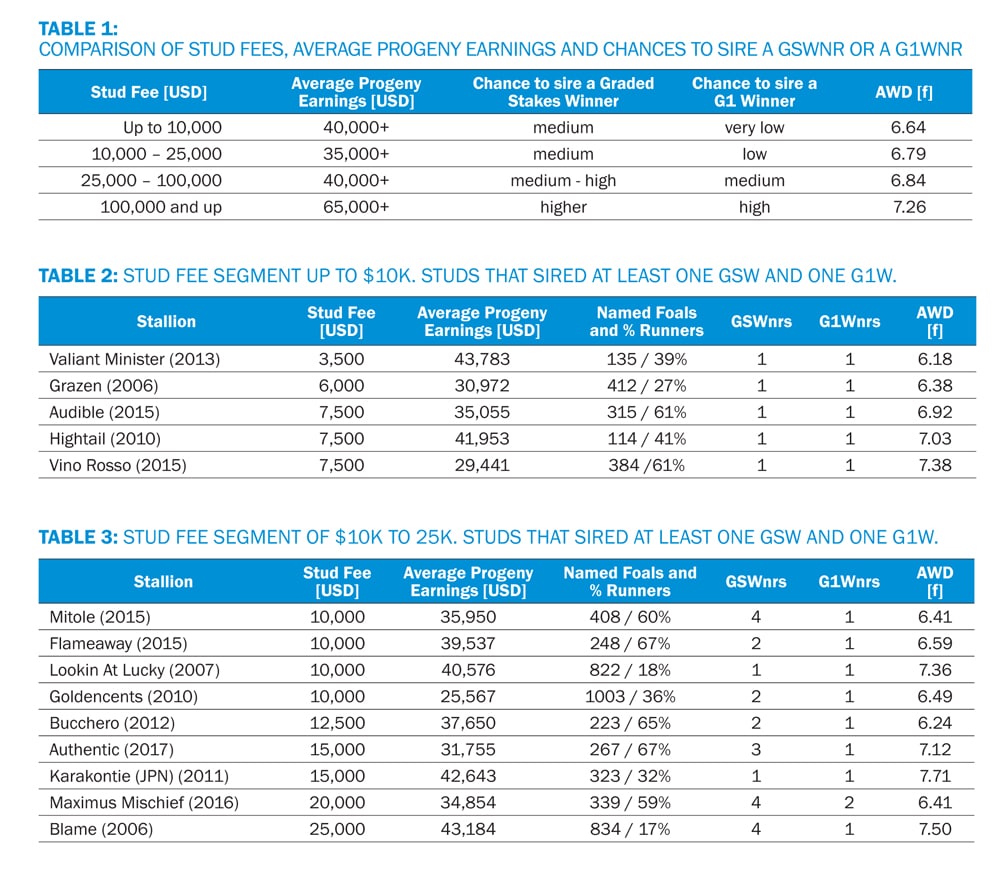
Table 1. It is further interesting to observe that the Average Winning Distance (AWD) increases with the stud fee – and the likelihood of breeding a G1 Winner.
Breeding Thoroughbreds is so much more, though, than just a financial investment and a return-on-investment consideration. It’s passion. It’s the anticipation before the race. And it’s the art of building pedigrees, of picking the most promising nick. Let’s explore why investment alone is not the key to success.
Magic on a Budget
Magic correlates more with the art of breeding than with budget. Remember, Federico Tesio is still considered the most successful breeder of all times. He worked with an impressive efficiency (success / dollar invested) emphasizing the importance of the art of breeding: building pedigree patterns, apply nicking strategies and using the gut feeling.
Using the same Top 150 Stallion List, there are 87 stallions (58%) with a stud under $25k and 60 stallions under $10k.
What Stories Do They Reveal?
First, let’s look at the segment of up to $25k (87 stallions). To narrow the most promising stallions down, I selected those who sired Graded Stakes Winners and G1 Winners, as this might reflect either genetic potential and/or a future rise in the stud fee and according sale prices. The following stallions stood out:
Table 2. In this table, Valiant Minister (LTE: $32,400) stands out for his low stud fee and high average progeny earnings. Also worth mentioning is that his offspring wins at the lowest Average Win Distance (AWD) in this segment. At the other end, Vino Rosso (LTE: $4,803,125) is remarkable, as his offspring had the lowest average earnings per runner, but wins at the longest distances (highest AWD). This could also be due to the fact that American racing is biased towards shorter distances, which can depress his winners’ earnings and make him appear less successful on this specific metric.
(Note: stallions with lower stud fees often have fewer foals than their peers in the top-tier segment and the value for Average Progeny Earnings might be heavily influences by one single top runner – not honestly reflecting the “true average” which statistically would be more faithfully reflected by the median of the progeny earnings.)
The stud fee segment represented in Table 2 shows that it is crucial to run a prospect at the most suited distance.
Second, let’s look at the segment between $10k and $25k (30 stallions). I again chose only those who had sired at least one Graded Stakes Winner and at least one G1 Winner:
Table 3. With the higher stud fees come higher numbers of GSWnrs and a slightly higher AWD. In this segment, Blame (2006) stands out with the highest average progeny earnings and his offspring perform
at the second-longest AWD (7.50f). Also, Maximus Mischief (2016) is remarkable, as he is the only stud in this segment to sire two G1 Winners. While the AWD of his offspring is rather low for the G1 Winner field, he is by Into Mischief (2005) that sired a whopping 16 GSWnrs and 5 G1wnrs. Further, offspring running at distances of 7f earn slightly more than the ones below 7f.
If your primary goal is to breed a racehorse and maximize your return on the stud fee investment, the data shows the most efficient hunting ground is in the lower fee brackets.
The youngest stallion in this segment is Authentic (2017); he’s sired 3 GSWnrs and his offspring performs best at distances over 7f. The second-highest average progeny earnings can be contributed to Karakontie (JPN); his offspring excel at the longest distances of this stud fee segment: 7.71f.
The foal counts and runners in Table 2 and 3 reveal that success in these stud fee segments is not about volume. Stallions like Valiant Minister, Hightail, and Maximus Mischief produced their winners from comparably small, selective crops, indicating a high strike rate for the right matings. In contrast, a larger foal count does not guarantee proportionally greater success, underscoring that the breeder’s focus must remain on pedigree compatibility, rather than the size of a stallion’s book.
What do all these numbers reveal? To make a long story short — genetic potential. Which one is the best stallion? The one that fits your mare! And that brings us back to Tesio, the art of breeding and how to select a suitable stallion for your mare.
Pick The Best Nick
Remember California Chrome – the “against all odds” stallion that retired with over $14 million in earnings and stands today at a fee of $13,333 in Japan? His sire stood most of his career for a fee $10,000. Just sheer luck? His peak stud fee of $40,000 indicates that he was always seen as the outlier by the industry. Looking at this pedigree, he has a very clean breeding approach with linebreeding to blue hen mares like Numbered Account, La Troienne, and Somethingroyal. He goes back several times to Princequillo, Buckpasser, Teddy, and is gender-balanced linebred to Mr Prospector. His talent is truly extraordinary – from a genetic point of view, though, not entirely unexpected.
Looking at the best runners of the above stallions and also exemplified in the pedigree of California Chrome, the absence of close but instead intentional line-breeding and/or purposeful combinations of bloodlines becomes apparent. The pedigrees show thoughtful reinforcement of key ancestors through different genetic sources and across more distant generations. Ideally, this creates a balanced, artfully networked influence with an above-average likelihood to breed a successful racer. While close line-breeding and inbreeding can be surprisingly successful, it is genetically a hit-or-miss tactic.
Hence, the approach to breed an outstanding foal is twofold: do the homework on the stallions and then choose the one that matches your mare. Building pedigree patterns over generations has been an excellent foundation on which the likelihood of breeding a unicorn is much favoured. The Magic Match remains a foundational strategy to breed outstanding runners. If pedigree patterns are combined with nicking strategies and the proven ability to sire superior offspring (considering statistics like the ones shown above), the chances of breeding a successful foal rise above average.
***
This article first appeared in the 2026 Canadian Thoroughbred Sire Book – order your copy here.
The Latest